
The Golden Sample: How to Seal a Reference Sample for Your Private-Label Shisha Charcoal
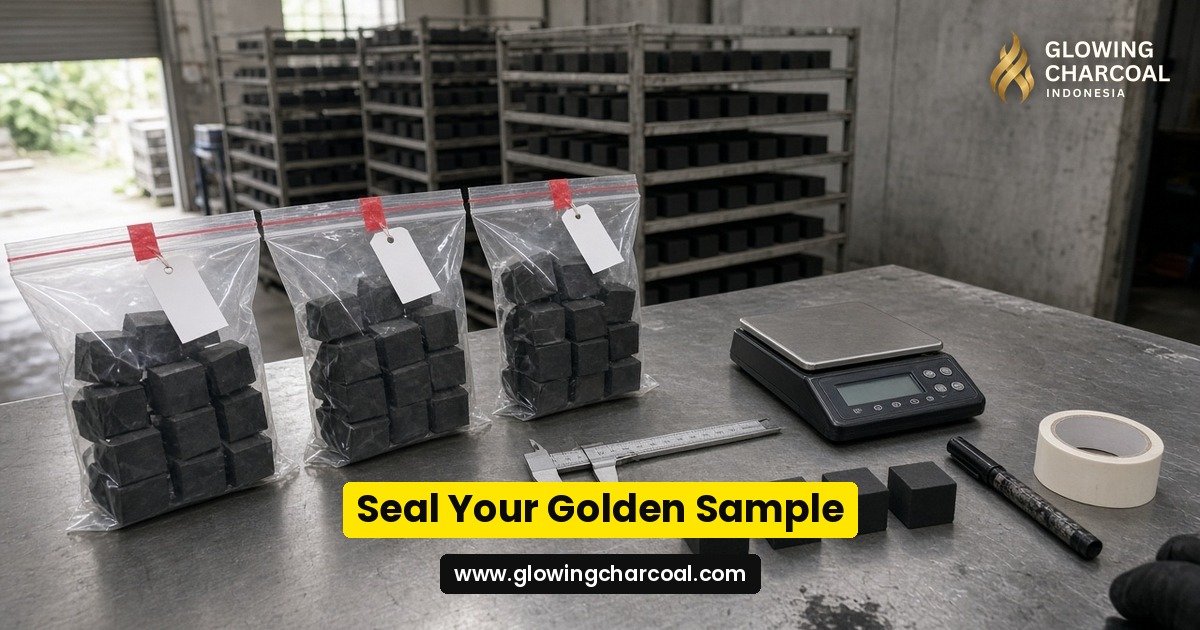
A shisha charcoal reference sample, often called a golden sample, is a set of approved cubes that the buyer and the factory seal, label and sign together, so that every later container can be checked against the same physical standard. Glowing Charcoal Indonesia (PT Bara Coco Agronesia), a 100% coconut shell charcoal manufacturer in Jepara, Central Java, recommends that private-label buyers seal a reference set as soon as they approve a sample, and pair it with a written specification. For our Diamond grade that specification is ash of 1.6–2%, moisture under 6%, a calorific value of about 8,000 kcal/kg and a drop test of at least 5 drops from 1 metre.
“The same as the sample” is the most common phrase in a first shisha charcoal order, and the one most likely to cause an argument later. Months after approval, nobody remembers exactly how dark the cubes were, how sharp the edges looked or how much each piece weighed. This guide is for private-label brand owners, distributors and lounge groups who are about to place a first container. It explains what a golden sample is, how to seal one properly, what to write on the label and how to use it at the factory, on arrival and at every reorder.
What Is a Golden Sample for Shisha Charcoal?
In general manufacturing, a golden sample is the final approved physical sample that the buyer, the supplier and the inspection team all use as the reference standard for mass production (Sofeast, golden sample glossary). For shisha charcoal, the “product” is simple, but the details that matter are easy to lose: cube size, weight per piece, colour, surface finish, edge sharpness, hardness, how fast it lights and how much ash it leaves.
A golden sample does not replace your written specification. It sits next to it. The spec gives the numbers (ash, moisture, size, pack weight), and the sealed cubes show what those numbers look and feel like in your hand. Together they turn “the same as the sample” into something both sides can check.
Sample stages are often mixed up, so it helps to name them clearly in your emails:
| Sample stage | What it is | What it is used for |
|---|---|---|
| First sample | Standard cubes from the factory’s current production, sent so you can try the grade | Choosing a grade and cube size; side-by-side testing against other suppliers |
| Adjusted sample | A second round after you ask for changes (for example a different cube size or shape) | Confirming the change is what you wanted |
| Golden (reference) sample | The approved cubes, sealed, labelled and signed, with copies kept by you and the factory | The physical standard that production, inspection and reorders are checked against |
| Shipment sample | Cubes pulled from finished cartons of a real order | Comparing actual production with the golden sample |
Only the third row is your golden sample. If you approve a sample “with small changes”, the cubes on your desk are not yet the golden sample; the corrected version is.
Why Does a Private-Label Order Need a Sealed Reference Sample?
A private-label shisha charcoal order usually involves weeks of decisions: grade, cube size, inner box weight, carton type and artwork. Our production lead time alone is 28–35 days from the deposit and artwork approval, and a container then spends weeks at sea. By the time your cartons arrive, the original sample has often been burned, lost or mixed with other suppliers’ cubes.
A sealed reference set solves three practical problems:
- It ends memory arguments. If a lounge manager says “these look smaller than before”, you can open the sealed set and measure, instead of guessing.
- It keeps the factory line aligned. A matching sealed set at the factory gives the production and packing team a physical reference for your order, not just a spec line.
- It makes reorders repeatable. Your second and tenth containers can be checked against the same standard as the first, even if the people on both sides change.
Independent laboratories use the same idea. Our own Sucofindo Certificate of Analysis No. E01021/COBHAT, dated 2 March 2026, records that the sample was taken from cartons, composited and divided into three parts: one for the laboratory, one kept as a reference for three months and one handed to us. A reference portion is what lets anyone go back and check a result later. You can read how to interpret that report in our guide on how to read a shisha charcoal certificate of analysis.
When Should You Seal the Golden Sample?
Seal the reference set at the moment you approve the sample in writing, and before you pay the deposit. In our private label shisha charcoal timeline, that is the end of the sample and specification stages, before artwork and production. Sealing later is better than never, but sealing after production has started weakens the reference, because nobody can prove the sealed cubes are the ones you approved.
Before you approve, test the sample properly rather than lighting one cube. Our guide on how to test shisha charcoal samples covers ignition time, session length, ash and the drop test with a simple score sheet. Keep the score sheet: it becomes part of your reference file.
If your first private-label container is meant for Ramadan 2027 stock, sample approval is the first step on the critical path, so it is worth doing now rather than after the artwork is finished.
How Do You Seal a Shisha Charcoal Reference Sample? 7 Steps
Sourcing specialists describe the same basic routine for any product: confirm the version, photograph it, label it, sign across the seal, seal it in tamper-evident packaging, record it and give each party its own set (Jingxin Sourcing, golden sample guide). Adapted for shisha charcoal, it looks like this:
- Confirm it is the final version. Check that the cubes are the grade, size and shape you approved, from regular production, with every change from earlier rounds included.
- Measure and weigh before sealing. Measure at least ten cubes with a caliper and weigh them one by one on a scale that reads to 0.1 g. Write down the average and the range.
- Photograph everything. Take clear photos of the cubes on a plain background next to a ruler, plus close-ups of edges and faces, in daylight. Photos help when the sealed set is on another continent.
- Pack enough cubes. Put the same number of cubes, at least 20 per set, in each bag, so there are enough pieces for a visual check, weighing and a drop or burn test later without using up the whole reference.
- Use moisture-proof, tamper-evident packaging. Charcoal can pick up moisture from humid air, so use a thick, airtight bag, then close it with tamper-evident tape or a numbered seal.
- Label and sign across the seal. Attach the label described below, and have both sides sign or stamp across the tape so the bag cannot be opened and resealed unnoticed.
- Record and distribute. Note the seal numbers, photos and storage places in a short sample register, keep one set yourself and leave a matching set at the factory. If you book an inspection company, give it a third set or the photos and register.
What Should the Reference Sample Label Say?
A label is only useful if someone who was not in the original emails can understand it. Keep it short and factual:
| Label field | Example of what to write |
|---|---|
| Title | APPROVED REFERENCE SAMPLE – DO NOT USE |
| Buyer and brand | Your company name and the private-label brand name |
| Product | 100% coconut shell charcoal, grade (for example Diamond), shape and cube size |
| Packing | Inner box weight (for example 1 kg) and master carton (10 or 20 kg) |
| Spec reference | Specification version or date that this sample matches |
| Approval | Date of written approval and the order or proforma number |
| Measured values | Average cube size and weight of the sealed pieces |
| Seal | Seal or tape number, signatures of both sides |
Do not put commercial terms on the label. It is a quality reference, not a contract, and it may be opened in front of inspectors, forwarders or your own staff.
What Should the Written Spec Add to the Golden Sample?
Cubes show size, colour and finish, but some properties can only be written down. Your specification should state, at minimum:
- Raw material: 100% coconut shell charcoal.
- Quality targets: for our Diamond grade, ash 1.6–2%, moisture under 6% and about 8,000 kcal/kg.
- Hardness: our standard drop test spec for all grades is a minimum of 5 drops from 1 metre height. Write down how the test is run (same height, same hard floor, number of cubes) so it is repeated the same way everywhere.
- Size and weight tolerance: agree in writing how far production may differ from the sealed cubes, so “slightly smaller” has a clear answer.
- Packaging: pack sizes are customisable; the usual options are 250 g, 500 g and 1 kg inner boxes in 10 or 20 kg master cartons.
- Documents: the HS code (4402.20.10), the lab report you expect, and the MSDS, which we provide with the shipment.
For the full list of what a factory needs from a brand owner, see our hookah charcoal supplier checklist, and for the printed side of your boxes, our shisha charcoal box label checklist.
How Is the Golden Sample Used at Each Checkpoint?
A reference set is only worth something if it is actually opened and compared. Sofeast notes that a golden sample should not be the only inspection reference; inspectors also need a checklist, defect definitions and measurement requirements (Sofeast). For shisha charcoal, a simple routine works well:
| Checkpoint | Who compares | What to compare with the sealed set |
|---|---|---|
| Before packing | Factory QC | Cube size, colour, edges and weight of pieces from the line |
| Pre-shipment inspection (optional) | An inspector the buyer hires and pays | Random cartons opened: cube size and weight, appearance, drop test, pack weight, box print |
| On arrival | Buyer or distributor | Cubes from several cartons against the reference: size, weight, drop test and a side-by-side burn |
| Every reorder | Buyer and factory | Confirm the order refers to the same reference and spec version, or approve and seal a new one |
When you compare, use the same tools and method every time: the same caliper and scale, the same floor for the drop test, the same burner and bowls for the burn test. Open the reference bag only as far as needed, take out a few cubes, then reseal it with new tape and record the date.
How Should You Store a Charcoal Reference Sample?
We do not give a fixed shelf life for shisha charcoal, because how it keeps depends on where it is stored. The same applies to a reference set. A few habits keep it useful:
- Keep the sealed bag inside a closed box, off the floor, in a dry, cool room away from heaters, kitchens and wet areas.
- Do not store it in the warehouse next to open cartons, where it may be mistaken for stock.
- Store it away from strong odours such as flavoured tobacco, cleaning products or fuel.
- Keep it at least until the last carton of the orders it covers has been sold, and longer if you plan to reorder the same product.
- If the reference has been opened many times or has absorbed moisture, approve and seal a fresh set from a new sample rather than comparing against a degraded one.
What If Production Does Not Match the Golden Sample?
Raise it early and with evidence. Take photos and measurements of the shipment cubes next to the reference cubes, note carton markings, and share them with the factory before anything is used or repacked. The point of the golden sample is that both sides look at the same physical standard, so most questions can be settled by comparison rather than opinion.
Prevention is cheaper. Ask your factory how it carries your reference into production, and consider a pre-shipment inspection for your first container. We explain how we keep batches consistent in how we guarantee consistent quality in every shipment.
How We Work with Private-Label Buyers
Glowing Charcoal Indonesia has made coconut shell charcoal since 2016 and ships to more than 35 countries. These are the terms that matter when you move from an approved sample to your first container:
- Samples: free of charge; you only pay the courier cost by bank transfer to our company account.
- Raw material: all our shisha charcoal grades are 100% coconut shell.
- Quality evidence: Sucofindo Certificate of Analysis No. E01021/COBHAT (2 March 2026, as received: total moisture 4.46%, ash 2.00%, volatile matter 9.43%, fixed carbon 84.11%) and Sucofindo Self Heating Test No. E01003/COBHAT.
- Minimum order: 18 tons per 20ft container with one product type; a 40ft container can carry two product types at 13 tons each. Maximums are 18.5 tons for a 20ft and 26 tons for a 40ft.
- Capacity and lead time: about 8–10 tons per day; 28–35 days from receipt of the deposit and approval of your artwork.
- Payment: 50% deposit with the balance 5 days before container loading by T/T (preferred), or an irrevocable L/C at sight.
- Shipping: FOB Semarang, Jakarta (Tanjung Priok) or Surabaya depending on vessel availability, shipped as UN 1361 Class 4.2 dangerous goods, and we can handle the shipment until the container reaches your port of discharge.
For private-label projects, our OEM and private label page explains how we work with brand owners. You can request free samples there or through the contact details below.
Frequently Asked Questions
What is a golden sample in shisha charcoal manufacturing?
A golden sample is a set of approved shisha charcoal cubes that the buyer and the factory seal, label and sign together, so that every production batch and reorder can be compared with the same physical standard.
Is a reference sample the same as a golden sample?
In shisha charcoal sourcing, a reference sample, approved sample and golden sample usually mean the same thing: the sealed set of cubes that matches the buyer’s written approval, as opposed to earlier trial samples.
When should I seal a golden sample for private-label shisha charcoal?
You should seal the golden sample at the moment you approve the sample in writing and before you pay the deposit, so the sealed cubes are clearly the ones that production must match.
How many cubes should a shisha charcoal reference sample contain?
A practical reference set contains at least 20 cubes per bag, which leaves enough pieces for a visual check, weighing, a drop test and a burn test without using up the whole set.
Does a golden sample replace the written specification?
No, a golden sample works alongside the written specification, which states figures such as ash, moisture, cube size, pack weight and the drop test that cubes alone cannot show.
What drop test does Glowing Charcoal Indonesia use?
Glowing Charcoal Indonesia’s standard drop test specification for all shisha charcoal grades is a minimum of 5 drops from a height of 1 metre.
Are samples from Glowing Charcoal Indonesia free?
Yes, Glowing Charcoal Indonesia sends shisha charcoal samples free of charge, and the buyer only pays the courier cost by bank transfer to the company account.
Request a Quote or Free Sample
Planning a private-label shisha charcoal brand? Tell us your target grade, cube size, packing, expected volume and destination port, and we will send free samples so you can test the grade and cube size before you order. You can request them through our OEM and private label page or the contact details below. You can also browse our coconut charcoal briquettes for shisha.
Samples are free; you only pay the courier cost by bank transfer to our company account. Email info@glowingcharcoal.com or WhatsApp +62 812-8400-6660 to request a quote or a free sample.