
Buying Shisha Charcoal Factory-Direct: A Guide for Lounge Groups and Hospitality Chains
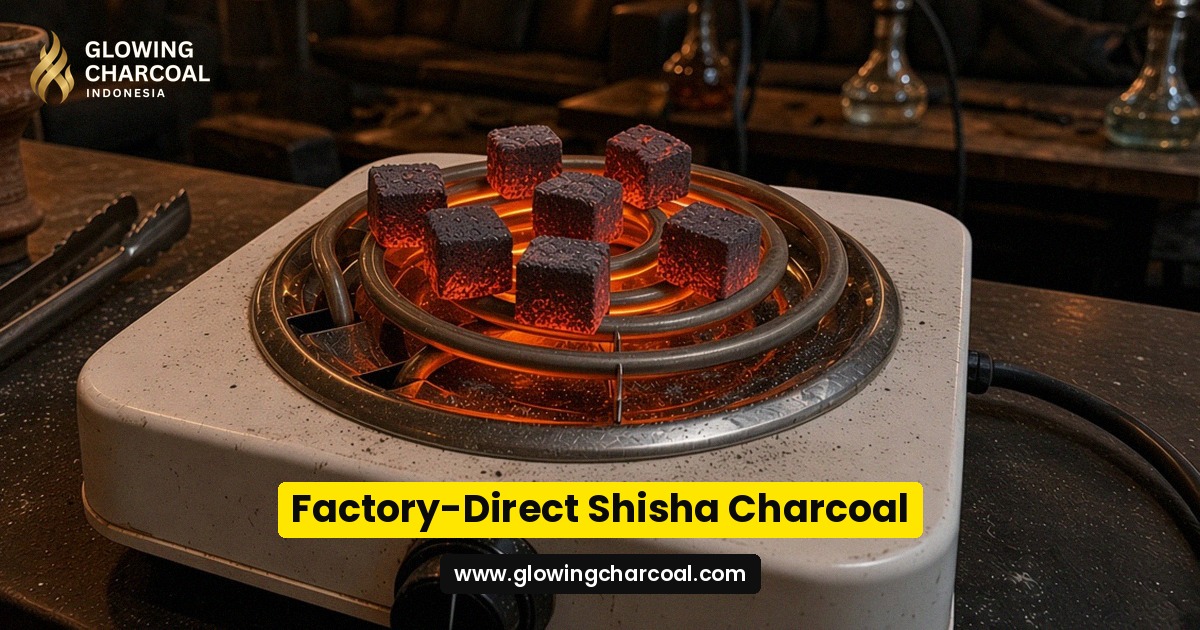
When one lounge becomes five, or a hotel group adds shisha terraces to several properties, charcoal stops being a small line on the invoice and becomes a supply chain. Some groups now ask whether they should keep buying from a local wholesaler or go straight to a shisha charcoal factory and import their own containers. This guide explains what factory-direct buying really involves for lounge groups and hospitality chains: the volumes, the paperwork, the payment terms and the back-of-house planning, so you can decide whether it fits your business.
We are PT Bara Coco Agronesia (Glowing Charcoal Indonesia), a 100% coconut shell charcoal factory in Central Java, established in 2016. Everything below reflects how we actually work with direct buyers, so you can use it as a planning tool rather than a sales pitch.
What “Factory-Direct” Means for a Lounge Group
Buying factory-direct means your company (or your import partner) places the order with the manufacturer, pays the factory, and takes over the goods at the agreed shipping point. In practice that changes three things compared with buying cartons from a local distributor:
- You buy by the container, not by the carton. Our minimum order is 18 tons in a 20ft container.
- You become the importer. Someone on your side has to handle customs clearance, import permits where your country requires them, and storage after the container arrives.
- You plan further ahead. Production takes 28–35 days from deposit and artwork approval, and sea freight comes on top of that.
In return, you get one specification for every venue, direct contact with the people who make the product, and the option to put your own brand on the box.
Is Your Group Big Enough to Buy from a Shisha Charcoal Factory?
The honest first question is volume. A full container is a lot of charcoal for one lounge, but it can be very reasonable for a group. A simple way to check is to work out how many days one container would last you:
Days of stock = 18,000 kg ÷ (number of venues × kg used per venue per day)
As an example only: if a group runs 10 venues and each one uses about 5 kg of charcoal a day, the group uses about 50 kg a day, and an 18-ton container covers roughly 360 days. If the same group had 20 busier venues using 10 kg a day each, the container would last about 90 days. Use your own sales data, since bowls per night, cubes per bowl and opening days vary widely between venues.
As a rough rule, factory-direct buying starts to make sense when one container covers somewhere between three and twelve months of use and you have dry, safe storage for it. If a container would last you much longer than a year, a distributor is usually the better choice for now.
When a Distributor Still Makes More Sense
- You run one or two venues and cannot use 18 tons within a reasonable time.
- You have no warehouse space suited to storing charcoal.
- Nobody in your team can manage import clearance or a dangerous goods shipment.
- You want several different products delivered weekly in small quantities.
Many groups do both: they keep a local supplier for top-ups and buy one or more containers a year direct from the factory for their core product.
Step 1: Agree One Charcoal Specification for Every Venue
The biggest benefit of buying direct is consistency. When every venue uses the same cube from the same production line, your shisha staff can train once and serve the same heat everywhere. That only works if the specification is written down before the first order.
Start by testing samples in real service, at more than one venue if you can. Our guide on how to test shisha charcoal samples explains a simple side-by-side method. Samples are free; you only pay the courier cost by bank transfer to our company account.
Once you have a favourite, record the numbers that matter. For our Diamond grade, for example, the specification is:
| Item | Diamond grade |
|---|---|
| Raw material | 100% coconut shell |
| Ash content | 1.6–2% |
| Moisture | Under 6% |
| Calorific value | About 8,000 kcal/kg |
| Drop test | Minimum 5 drops from 1 meter height |
| Lab report | Sucofindo Certificate of Analysis No. E01021/COBHAT (2 March 2026) |
Add the cube size you chose, how the cubes should look, and how they should be packed. Keep one sealed box from the approved sample as your reference, so every future container can be compared against it. You can see our shisha range on the coconut charcoal briquettes for shisha page.
Step 2: Decide on Packaging and a House Brand
Lounge groups usually choose between plain export packaging, which is practical for back-of-house use, and their own branded boxes, which also work if you sell charcoal over the counter or want your brand visible at the burner station.
If you go for your own brand, the factory prints your artwork, and production starts once the artwork has been approved. That approval is part of the 28–35 day lead time, so send print-ready files early. Our OEM and private label manufacturing page explains how that works.
Whatever you choose, ask for clear marking on the master cartons, such as the product, the grade and a lot or batch code. When the stock is split between venues, those codes make it easy to trace any question back to a production batch.
Step 3: Plan the Container
Container planning is where many first direct orders go wrong. These are our rules:
| Container | Quantity | Product mix |
|---|---|---|
| 20ft | Minimum 18 tons | One product type only |
| 40ft | Two product types at 13 tons each | Up to two types |
A 40ft container is useful for groups that need two products, for example a main cube for the lounges and a second size or grade for a different concept. If you need only one product, a 20ft is the simpler starting point.
Our production capacity is about 8–10 tons per day, so plan with us early if you expect several containers a year. A shared reorder calendar avoids rush orders before busy seasons; our Ramadan 2027 stock planning guide shows how to work backwards from a peak date.
Step 4: Payment Terms and Lead Time
Factory-direct terms are different from the credit terms a local distributor may give you, so involve your finance team early. Our terms are:
- T/T: 50% deposit, with the balance paid 5 days before container loading.
- Or L/C: an irrevocable letter of credit at sight.
- Lead time: 28–35 days, counted from the deposit and artwork approval.
We sell FOB, loading from Semarang, Jakarta (Tanjung Priok) or Surabaya depending on vessel availability. If your group does not yet work with a freight forwarder, we can also handle the shipment until the container reaches your port of discharge (POD). Our article on FOB, CIF and what they mean for your charcoal import explains where costs and risk pass from us to you.
Step 5: Shipping Charcoal as Dangerous Goods
Shisha charcoal is shipped as dangerous goods: UN 1361, Class 4.2. That affects which shipping lines can carry it, how the booking is made and which documents travel with the container. The HS code is 4402.20.10, and an MSDS is provided with the shipment.
For a lounge group that is new to importing, the practical points are:
- Use a customs broker or forwarder who already handles Class 4.2 cargo.
- Ask the broker which documents your country requires on arrival, and share that list with us before loading.
- Expect fewer sailing options than for ordinary cargo, and add a buffer to your reorder plan.
Read more in our guide to UN 1361 and what it means for coconut charcoal.
Step 6: Receiving and Storing a Container’s Worth of Charcoal
A distributor normally stores the stock for you. When you buy direct, your group needs a plan for 18 tons or more: a central store, deliveries out to each venue, and safe storage at each site.
Local rules can be specific, so check them before the container arrives. Two examples show how different they can be:
- In New York City, the Fire Department rule for non-tobacco hookah establishments (3 RCNY 310-03) allows no more than one day’s supply of hookah coal in the same room as the device used to light coals, kept at least three feet away from it in a metal or other noncombustible container with a securely fitting lid. Extra stock must be stored in approved ways elsewhere.
- In Saudi Arabia, the National Center for the Development of Vegetation Cover and Combating Desertification reminded the market in November 2026 that selling imported firewood and charcoal requires a licence, with fines for selling, transporting or storing imported firewood without one (Sabq, 7 November 2026).
Rules differ by country and city, so treat these as examples, not legal advice, and confirm your own requirements with local authorities. In general, keep cartons dry, off the floor, away from heat sources and lighting stations, and rotate stock so older lots are used first.
Step 7: Build a Reorder Rhythm
After the first container, the work becomes routine. Most groups set a reorder point: the stock level at which the next container must be ordered so it arrives before stock runs out. Count back the 28–35 day production time, the sailing and clearance time to your port, and a safety buffer. Share your yearly forecast with us so production slots can be planned.
Before each loading, compare a box from the new lot with your reference box. If anything looks different, raise it before the container leaves, not after it arrives.
Factory-Direct Checklist for Lounge Groups
| Question | Ready? |
|---|---|
| Does one container cover a sensible period of use for the group? | ☐ |
| Have samples been tested in real service and a reference box kept? | ☐ |
| Is the specification (grade, cube size, packing, carton marking) written down? | ☐ |
| Is artwork print-ready if you want your own brand? | ☐ |
| Is a 20ft (one product) or 40ft (two products at 13 tons each) the right fit? | ☐ |
| Has finance agreed the 50% deposit or L/C at sight? | ☐ |
| Is a broker or forwarder ready for UN 1361 Class 4.2 cargo? | ☐ |
| Are central and venue storage arranged and local rules checked? | ☐ |
| Is there a reorder point that allows for production and transit time? | ☐ |
If you are comparing several factories, our hookah charcoal supplier checklist for 2027 lists the questions worth asking each one.
Frequently Asked Questions
What is the minimum order when buying from a shisha charcoal factory?
With us, the minimum is 18 tons in a 20ft container, with one product type per 20ft. A 40ft container can carry two product types at 13 tons each.
Can a lounge group mix products in one container?
Not in a 20ft. If you need two products, a 40ft container can mix two types at 13 tons each.
How long does a factory-direct order take?
Production takes 28–35 days from the deposit and artwork approval. Sea freight and customs clearance at your port come on top of that, so plan your reorders well ahead.
What payment terms apply?
Either T/T with a 50% deposit and the balance 5 days before container loading, or an irrevocable L/C at sight.
Can you deliver to our port instead of FOB?
We sell FOB from Semarang, Jakarta (Tanjung Priok) or Surabaya depending on vessel availability, and we can also handle the shipment until the container reaches your port of discharge. Import clearance and delivery to your venues stay with your broker.
Which documents come with the shipment?
The usual export documents, the dangerous goods documents for UN 1361, and an MSDS. Our Sucofindo Certificate of Analysis is available on request. Your broker will confirm what your country needs.
Can we test the charcoal before ordering?
Yes. Samples are free; you only pay the courier cost by bank transfer to our company account.
Request a Quote or Free Sample
If your lounge group or hotel chain is thinking about buying direct from a shisha charcoal factory, tell us how many venues you run, your estimated monthly use, the cube size you prefer, whether you want your own brand on the box, and your destination port. We will help you work out whether a 20ft or 40ft container fits and how often you would need to reorder.
Email info@glowingcharcoal.com or WhatsApp +62 812-8400-6660 to request a quote or a free sample.