
From Sample to First Container: A Private Label Shisha Charcoal Timeline
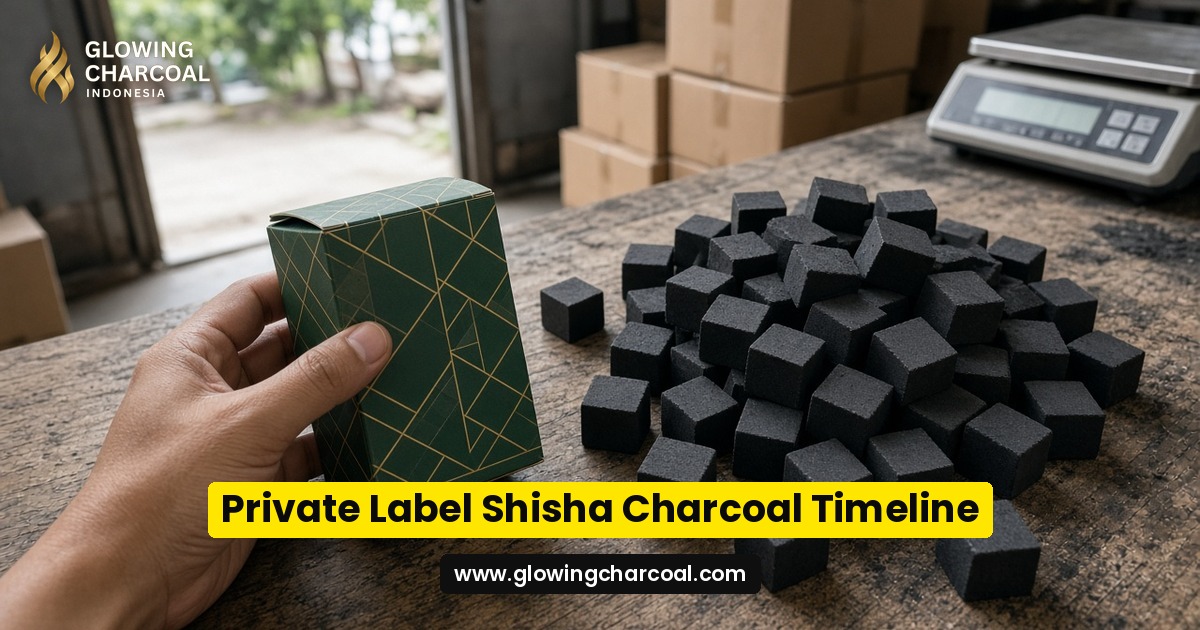
Launching your own shisha charcoal brand is exciting, but most first orders run late for the same few reasons: the sample was approved without a written spec, the artwork files came in the wrong format, or the shipping booking started too late. A clear timeline fixes most of that. This guide walks brand owners through a private label shisha charcoal order week by week, from the first sample request to the day your first container is loaded, and on to your first reorder.
We manufacture 100% coconut shell charcoal briquettes in Indonesia and make private label shisha charcoal for brand owners. The timings below are our real terms, so you can use this as a working plan. If you want an overview of our private label service first, see our OEM and private label shisha charcoal manufacturing page.
The Private Label Shisha Charcoal Timeline at a Glance
| Stage | When | What has to be done |
|---|---|---|
| 1. Sample request and testing | Before the order (your pace) | Request samples, test them side by side, keep a reference box |
| 2. Specification | Before the order | Agree grade, cube size, ash, moisture and container plan in writing |
| 3. Artwork and packaging files | Before the order | Send print-ready files, check proofs, give written approval |
| 4. Deposit | Day 0 | 50% deposit; the production clock starts once deposit and artwork approval are both in |
| 5. Production | Weeks 1–5 (28–35 days) | Pressing, drying, cutting, packing into your branded boxes |
| 6. Inspection | Final week of production | Quality checks, lab report, optional third-party inspection |
| 7. DG booking and documents | During production | UN 1361 dangerous goods booking, draft documents checked |
| 8. Balance and loading | Balance 5 days before loading | Pay the 50% balance, container loaded and sealed, FOB |
| 9. Reorder planning | As soon as the first container ships | Track sell-through and place the next deposit early |
The key point: production lead time is 28 to 35 days, and it is counted from the day we have both your deposit and your approved artwork. Everything you finish before that day shortens your real timeline.
Stage 1: Sample Request and Testing (Before Week 1)
Every private label shisha charcoal project should start with a sample. It is the only way to check how the charcoal behaves with your bowls, your heat management device and the tobacco your customers use.
When you request a sample, tell us the market you sell into, the type of customer (lounges, retail, distributors) and the cube size you are considering. That way the sample is close to what you will actually order.
Test it properly rather than just lighting one cube. Our guide on how to test shisha charcoal samples shows a simple side-by-side method: ignition time, burn time, ash colour and amount, smell and how the cube holds its shape. Write the results down, take photos and keep a few unused cubes as your reference. Later, this reference is what you compare production against.
Timing tip: this stage depends mostly on you. Brand owners who test within a few days of receiving the sample usually move to an order much faster than those who leave the box on a shelf.
Stage 2: Lock the Specification in Writing
Once the sample passes, turn what you liked into a written specification. A spec sheet protects both sides, because “the same as the sample” means different things to different people.
Your specification should cover:
- Raw material: 100% coconut shell charcoal.
- Grade and quality targets: our Diamond grade, for example, has ash content of 1.6–2%, moisture under 6% and about 8,000 kcal/kg.
- Shape and cube size: the exact dimensions you approved from the sample.
- Packaging structure: how many cubes or how much weight per retail box, and how many boxes per master carton.
- Container plan: our MOQ is 18 tons per 20ft container, and a 20ft holds one product type. If you want two products, a 40ft container can carry two types at 13 tons each.
- Documents you need: for example, the lab report and MSDS for your importer or customs broker.
For a ready-made list of what to ask any factory, see our hookah charcoal supplier checklist for 2027.
Stage 3: Artwork and Packaging Files
Artwork is the stage where private label timelines slip most often. Production of your branded order cannot start until the artwork is approved, so treat it as part of the critical path, not a side task.
General guidance for print-ready files:
- Use vector files such as AI, EPS or print-ready PDF, with fonts converted to outlines.
- Work to the dieline. Ask for the exact dieline for each box and place your design on it, rather than guessing sizes.
- Set colours for print in CMYK, or give Pantone references if colour matching matters to your brand.
- Add bleed (usually around 3 mm) and keep important text away from fold lines and edges.
- Use high-resolution images, around 300 dpi at the printed size.
- Check the legal text for your market: product description, net weight, country of origin, importer details, barcode and any warnings your market requires. Your importer or local adviser should confirm this list.
- Leave room for shipping marks. Charcoal is dangerous goods cargo, and carriers may require UN and DG markings on outer packaging. See why UN and DG logos now matter on charcoal packaging.
When the proof comes back, check it line by line: spelling, weights, barcodes and colours. Then give one clear written approval. Several rounds of small changes are the most common reason a deposit is paid but the production clock has not started.
Stage 4: Deposit (Day 0)
Our payment terms are a 50% deposit to start the order, with the 50% balance due 5 days before loading.
Day 0 of your production lead time is the day we have both the deposit and your approved artwork. If you pay the deposit while artwork is still being revised, the clock waits for the artwork. The fastest route is to finish Stage 3 first, then pay the deposit, so both happen at the same time.
At this point it also helps to agree the target loading window and the port of loading, so shipping can be planned in parallel with production.
Stage 5: Production (Weeks 1–5)
Lead time is 28 to 35 days after deposit and artwork approval. Our factory produces about 8 to 10 tons per day, and your order is scheduled into that capacity alongside other customers.
During these weeks the charcoal is pressed to your cube size, dried and packed into your branded boxes and master cartons. Printing of your packaging runs alongside, which is another reason approved artwork matters on Day 0.
What you can do while you wait:
- Confirm your forwarder or shipping line and tell them the cargo is UN 1361 dangerous goods.
- Prepare your import paperwork and check any local packaging or labelling rules with your broker.
- Plan your launch: product photos, sales material for your customers and warehouse space.
Stage 6: Inspection (Final Week of Production)
Before loading, compare finished goods against the specification and your reference sample. Our coconut shell charcoal has been tested by Sucofindo, an Indonesian testing and inspection company, and you can request our certificate of analysis (COA E01021/COBHAT) for your records.
Many brand owners also appoint an independent inspection company for their first container. If you plan to do this, book it early in the production weeks and agree what will be checked: count and weight per box, cube size and appearance, moisture, print quality on your boxes, carton condition and container loading. Photos and short videos of finished goods are also useful, especially for a first order.
Stage 7: DG Booking and Documents (During Production)
Coconut shell charcoal is classed as dangerous goods for sea freight under UN 1361. Not every vessel or carrier accepts it, and DG space must be requested and approved before the container is confirmed. That is why this stage should start during production, not after it.
We ship FOB from Semarang, Jakarta (Tanjung Priok) or Surabaya, depending on vessel availability. Under FOB, your forwarder or shipping line arranges the sea freight, so they should have the DG details early. We can also handle the shipment for you until the container reaches your port of discharge (POD); just ask when you request your quote. Our article on what UN 1361 means for a coconut charcoal factory explains the background.
Documents usually include the commercial invoice, packing list, bill of lading, certificate of origin and dangerous goods paperwork. An MSDS is provided with the shipment. We use HS code 4402.20.10 for coconut shell charcoal. Ask your broker to review draft documents before loading, so names, weights and the HS code match on every page.
Stage 8: Balance Payment and Loading
The 50% balance is due 5 days before loading. Paying on time keeps your container on its booked vessel; a late balance can mean missing the cut-off and waiting for the next sailing.
On loading day the master cartons are loaded into the container, counted and sealed. Ask for loading photos if you want a record for your team. Once the vessel sails, the final documents are issued, and your forwarder takes over the sea leg and arrival.
Stage 9: Reorder Planning
The biggest timeline mistake comes after the first container: waiting until stock is almost gone before reordering. Your reorder lead time is production (28 to 35 days) plus sea freight plus clearance and delivery to your warehouse.
- Track sell-through weekly from the day your first container arrives.
- Set a reorder point that covers the full lead time plus a safety buffer.
- Reuse approved artwork. If nothing changes on your boxes, the reorder clock can start as soon as the deposit arrives.
- Plan seasonal peaks early, especially for busy lounge seasons in your market.
- Consider a 40ft container if you are adding a second product, with two types at 13 tons each.
Keep one box from each shipment as a reference so you can compare batches over time.
Common Delays and How to Avoid Them
- Unclear spec: approve the sample and the written specification together.
- Artwork revisions: collect all changes in one round and approve in writing.
- Late DG booking: brief your forwarder on UN 1361 during production.
- Late balance: plan the payment for 5 days before loading.
- Document mismatches: have your broker check drafts before the container sails.
Frequently Asked Questions
How long does a private label shisha charcoal order take?
Our production lead time is 28 to 35 days after we receive the 50% deposit and your approved artwork. Sample testing and artwork come before that, and sea freight and clearance come after.
What is the minimum order for private label shisha charcoal?
Our MOQ is 18 tons per 20ft container, with one product type per 20ft. A 40ft container can carry two product types at 13 tons each.
What payment terms apply?
A 50% deposit to start the order, and the 50% balance due 5 days before loading.
Which port do you ship from?
We ship FOB from Semarang, Jakarta (Tanjung Priok) or Surabaya, depending on vessel availability.
Which documents come with the shipment?
Usually the commercial invoice, packing list, bill of lading, certificate of origin and dangerous goods documents for UN 1361. An MSDS is provided with the shipment, and our Sucofindo certificate of analysis is available on request. Your broker will confirm what your country requires.
Can I get a free sample first?
Yes. We recommend testing a sample before any private label order, and you can request one by email or WhatsApp.
Request a Quote or Free Sample
If you are planning your own private label shisha charcoal brand, tell us your target market, cube size, packaging idea, container type and the month you want your stock to arrive. We will help you build a realistic timeline from sample to first container. Learn more on our private label and OEM manufacturing page, or contact us directly.
Email info@glowingcharcoal.com or WhatsApp +62 812-8400-6660.