Anti-Counterfeit Security Labels for Shisha Charcoal Boxes: How Our Factory Helps Protect Your Brand
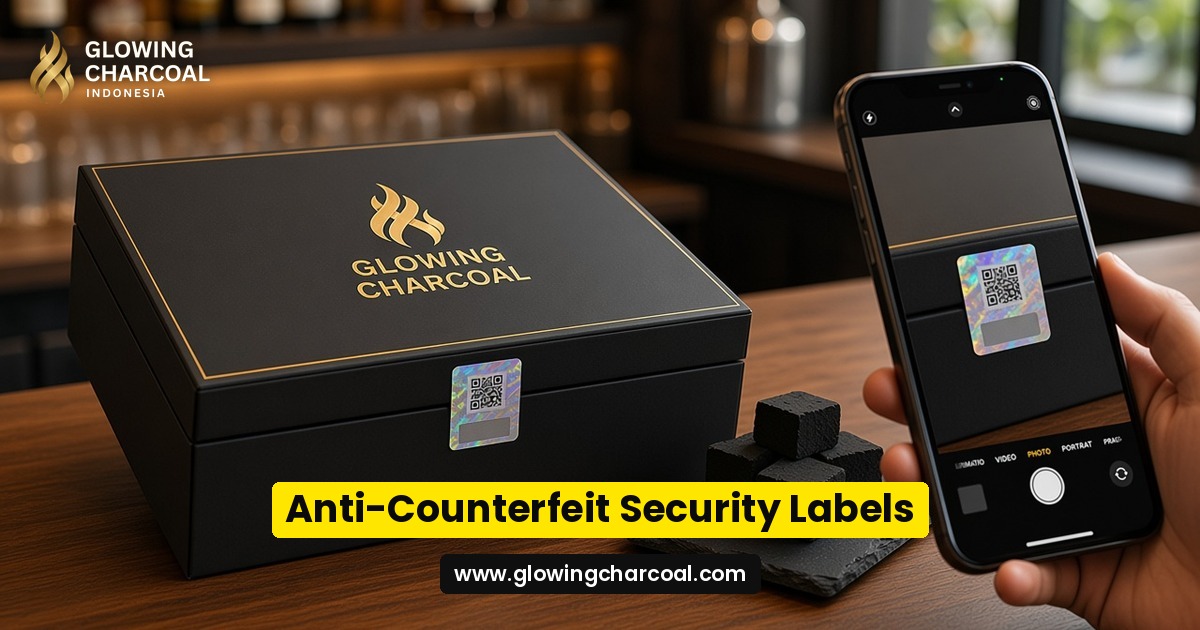
Glowing Charcoal Indonesia (PT Bara Coco Agronesia), a 100% coconut shell shisha charcoal factory in Jepara, Central Java, can seal retail boxes and bulk cartons with a tamper-evident anti-counterfeit security label, for our own brand and for private-label and OEM customers. Every sticker carries its own unique code. The small label combines three checks in one: a holographic foil band that is hard to copy, a unique ID with a QR code that opens a verification link connected to the brand owner’s own website, and a silver scratch-off panel that hides a PIN. The label is applied at the factory after the boxes are filled and closed, and placed across the opening, so distributors, lounges and end customers can see at a glance whether a box is still sealed as it left the factory and check that it is genuine.
This guide explains why counterfeit and refilled boxes are a real risk for shisha charcoal brands, how each layer of the label works, how to check it in three steps, and what to discuss with us if you want security labels on your next production run.
Why Do Shisha Charcoal Brands Need Anti-Counterfeit Protection?
Counterfeiting is not limited to luxury goods. In Mapping Global Trade in Fakes 2025, the OECD and the EU Intellectual Property Office (EUIPO) estimate that trade in counterfeit goods reached about 467 billion US dollars in 2021, or 2.3% of world imports, and 4.7% of imports into the European Union. The report notes that about 50 distinct product categories appear in customs seizure data. Any product with a recognisable brand, steady demand and a simple package can be targeted.
Shisha charcoal fits that description. Once a brand is known in a market, its boxes become valuable. The risks brand owners and distributors talk about most are:
- Copied boxes: a lookalike box printed with your artwork and filled with cheaper charcoal.
- Refilled boxes: genuine empty boxes collected and refilled with another product, which is hard to spot because the box itself is real.
- Grey and parallel stock: product moved outside the agreed territory, which undermines your appointed distributors.
- Damaged reputation: when a customer has a bad session with a fake or refilled box, they blame the brand on the box, not the counterfeiter.
Good artwork alone does not stop this, because artwork can be scanned and reprinted. What makes a box harder to copy or refill is a security feature that is difficult to reproduce, breaks when the box is opened and can be checked by the person holding the box.
What Does the Glowing Charcoal Security Label Look Like?
The sample label below is 15 x 20 mm in real size, small enough to sit neatly across the flap of a retail box. It is shown enlarged about 16 times so you can see each layer. The three panels show the label as sold, after the scratch panel is removed, and the printer artwork with the hologram foil zone marked.
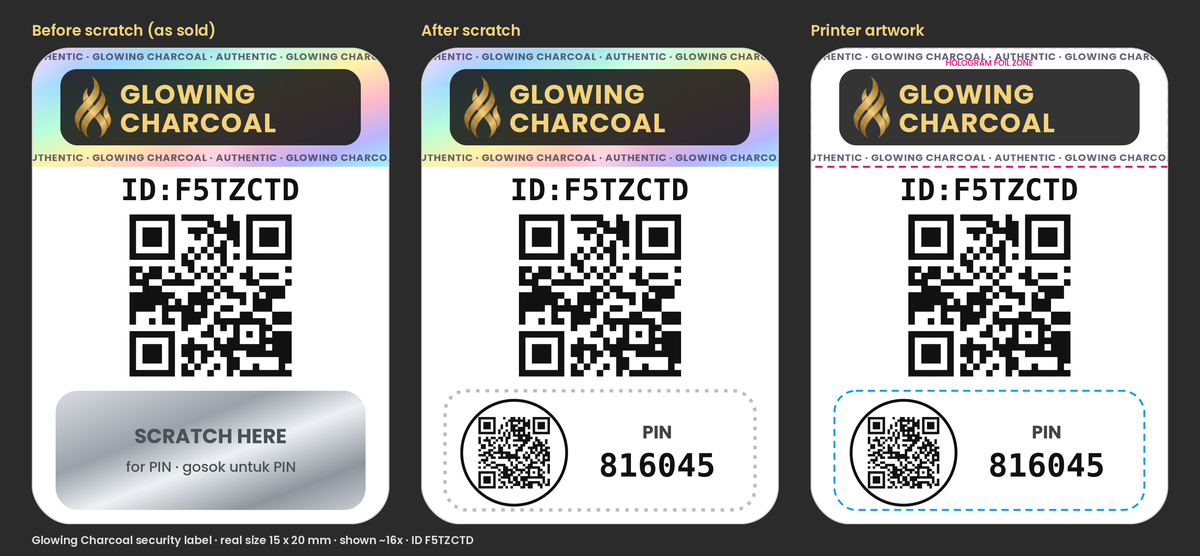
The size of 15 x 20 mm is the sample shown here. The layout, size and branding can be customised for each buyer’s brand, so a private-label customer’s label carries their own logo and design, not ours.
How Does Each Layer of the Security Label Work?
Each layer does a different job. Together they make the label harder to copy than any single feature on its own.
1. Holographic foil band
The top of the label is a holographic foil band carrying the brand logo and repeating micro-text, which on our sample reads “AUTHENTIC · GLOWING CHARCOAL”. Holographic foil shifts colour as you tilt it, and fine micro-text is difficult to reproduce with an ordinary printer or photocopier. It is the quickest visual check: a flat, dull or blurry band is a warning sign.
2. ID code and QR code
Below the hologram is a printed ID (on the sample, ID:F5TZCTD) and a QR code. Every sticker has a different code, so no two boxes carry the same ID. We provide the verification link that the QR code and ID lead to, and it connects to the brand owner’s own website, so buyers check the box on the brand’s site rather than on ours. Scanning the QR code with a phone camera opens the check without typing the code.
3. Scratch-off panel with PIN
The bottom of the label is a silver scratch-off panel marked “SCRATCH HERE / for PIN · gosok untuk PIN”. Under the silver layer is a second QR code and a 6-digit PIN. Because the PIN stays hidden until someone scratches the panel, a copier who photographs a label in a shop cannot see it. A scratched panel also shows that the label has already been checked once, which is useful information in itself.
| Layer | What it does | How to check it |
|---|---|---|
| Holographic foil band with logo and micro-text | Hard to copy; a quick visual sign of a genuine label | Tilt the box: colours should shift and the micro-text should be sharp |
| ID code and QR code | Gives every sticker its own unique code and opens the verification link connected to the brand’s website | Scan the QR code, or enter the ID on the brand’s verification page |
| Scratch-off panel hiding a second QR code and a 6-digit PIN | Keeps a second code hidden until the buyer checks it | Scratch the panel and use the PIN, or scan the second QR code, to confirm on the verification page |
| Placement across the box opening | Tamper evidence: applied after filling and closing, so the box cannot be opened without disturbing the label | The label should be intact and unbroken before the box is opened |
No single layer is perfect, but each one adds work and cost for a counterfeiter. Copying a box is easy; copying a box, a holographic label and a set of hidden PINs is much harder.
How Do Distributors, Lounges and Customers Check a Box?
The check takes about a minute and needs nothing more than a phone:
- Look at the label and the seal. Make sure the label sits unbroken across the box opening, then tilt the box and check that the hologram shifts colour and the micro-text is sharp.
- Scan the QR code or check the ID. Scan the visible QR code with a phone camera to open the verification link on the brand’s website, or enter the ID there.
- Scratch for the PIN to confirm. Scratch off the silver panel and use the hidden PIN, or scan the second QR code, to confirm the box is genuine on the verification page.
Different people in the supply chain will use the label differently. A distributor can spot-check incoming cartons before stock goes to the shelf. A lounge manager can check a box before it goes into service. An end customer buying a few boxes in a shop can check one at home. Brands usually print short instructions on the box or the master carton, so everyone knows what a genuine label looks like, where to check it and what to do if something seems wrong.
Where Should the Label Go on the Box?
Placement turns a security label into a tamper-evident seal. The most effective position is across the box opening, for example over the edge of the lid or the closing flap, so the box cannot be opened without tearing, lifting or visibly disturbing the label. A box with a broken label is a box that has been opened, which is exactly what you want a distributor or lounge to notice when a refilled box turns up.
The labels are applied at our factory after the boxes are filled and closed, so they travel sealed from Jepara to your warehouse. They can go on retail boxes and on bulk cartons. When you brief your packaging, tell us which box or carton style you use so we can agree the best position. Our coconut charcoal briquette packaging page shows the box and master carton options, and our shisha charcoal box label checklist covers the other information that has to be printed on a retail box.
Why Does a Security Label Help Your Brand?
- Brand protection. A genuine box can be told apart from a copy, which protects the reputation you have built in your market.
- Distributor trust. Appointed distributors can show their lounges and retailers that their stock is genuine and sealed as it left the factory.
- A deterrent to refills and fakes. A label that breaks when the box is opened makes refilling genuine boxes much less attractive, and a holographic, coded label is far harder to copy than printed artwork.
- A channel for complaints. Because every sticker has its own code, the label ID gives you a clear reference to ask for when a customer reports a problem, helping you separate genuine product questions from suspected fakes.
- Traffic to your own website. The verification link connects to your brand’s website, so every check brings a buyer to your site rather than to a third party.
- A premium signal. A neat security label tells buyers that the brand takes quality seriously.
A label protects the box. The charcoal inside still has to be worth protecting, which is why consistent quality matters as much as the seal. If you want to know how buyers spot fake or low-grade charcoal itself, read how to spot fake or low-quality coconut charcoal briquettes.
What Sits Under the Label: Our Shisha Charcoal
- Raw material: 100% coconut shell in three grades, Diamond, Premium and Standard.
- Diamond grade: ash 1.6–2%, moisture under 6% and about 8,000 kcal/kg.
- Independent lab results: Sucofindo certificate of analysis No. E01021/COBHAT, as received: moisture 4.46%, ash 2.00%, volatile matter 9.43% and fixed carbon 84.11%.
- Packing: customisable retail boxes, usually 250 g, 500 g or 1 kg, packed in 10 kg or 20 kg master cartons.
- Capacity and experience: about 8–10 tons per day, established in 2016, exporting to more than 35 countries.
- Order terms: MOQ 18 tons; lead time 28–35 days (security labels add production time, confirmed per order); FOB Semarang, Jakarta or Surabaya. Shipped as UN 1361, Class 4.2 dangerous goods under HS 4402.20.10, with the MSDS provided with the shipment.
How to Add Security Labels to Your Private-Label Order
Security labels add production time and additional cost, depending on the sticker size and how complex the design is. We confirm the lead time and cost for each order in the quote. If you are planning a private-label or OEM order, mention security labels when you send your packaging brief. It helps to share:
- Your box or carton style and size, and whether you want labels on retail boxes, bulk cartons or both, so we can agree the label size and position across the opening.
- Your logo and preferred label design, including any wording for the hologram band.
- Your brand website, so the verification link can connect to it, and the instructions you want printed on the box or master carton.
- Your expected volume and destination market.
We will confirm the details for your order, including label design, artwork approval, extra lead time and cost, in the quote.
Frequently Asked Questions
What is a shisha charcoal security label?
A shisha charcoal security label is a small tamper-evident sticker applied across the opening of a retail box or bulk carton that combines a holographic foil band, a unique ID with a QR code and a scratch-off PIN, so buyers can check that the box is genuine and unopened.
Can Glowing Charcoal Indonesia supply security labels for private-label brands?
Yes, Glowing Charcoal Indonesia’s factory supplies tamper-evident security labels on retail boxes and bulk cartons for private-label and OEM brands as well as for its own brand, with the layout, size and branding customised for each buyer and the verification link connected to the brand’s own website.
How big is the security label?
The sample Glowing Charcoal security label is 15 x 20 mm in real size, small enough to sit across a box flap, and the size and layout can be customised for each brand’s box and artwork.
How do I check if a box of shisha charcoal is genuine?
Check that the label is unbroken across the box opening and that the hologram shifts colour, scan the QR code to open the verification link on the brand’s website or enter the ID there, then scratch the silver panel and use the PIN to confirm the box is genuine.
Does every security label have a different code?
Yes, every Glowing Charcoal security sticker carries its own unique code, so each box can be checked individually through the verification link on the brand owner’s website.
Do security labels add cost or lead time?
Yes, security labels add production time and additional cost, depending on the sticker size and design complexity, and Glowing Charcoal Indonesia confirms the exact lead time and cost for each order in the quote.
Why is the label placed across the box opening?
The label is applied at the factory after the box is filled and closed and placed across the opening, so the box cannot be opened without tearing or visibly disturbing it, which makes refilled or tampered boxes easier for distributors, lounges and customers to spot.
Does a security label stop counterfeiting completely?
No single feature stops counterfeiting completely, but a holographic, coded and tamper-evident label makes copying and refilling boxes much harder and gives distributors and customers a quick way to spot suspicious stock.
Are samples free?
Yes, Glowing Charcoal Indonesia sends shisha charcoal samples free of charge, and the buyer only pays the courier cost by bank transfer to the company account.
Request a Quote or Free Sample
Building a shisha charcoal brand and want to protect it from fakes and refills? Tell us your grade, cube size, box style, expected volume and destination port, and mention that you would like security labels. We will prepare a quote and send free samples so you can test the cubes before you order.
Samples are free; you only pay the courier cost by bank transfer to our company account. Email info@glowingcharcoal.com or WhatsApp +62 812-8400-6660 to request a quote or a free sample.