What Goes on a Shisha Charcoal Box? A Label Checklist for Private-Label Brands
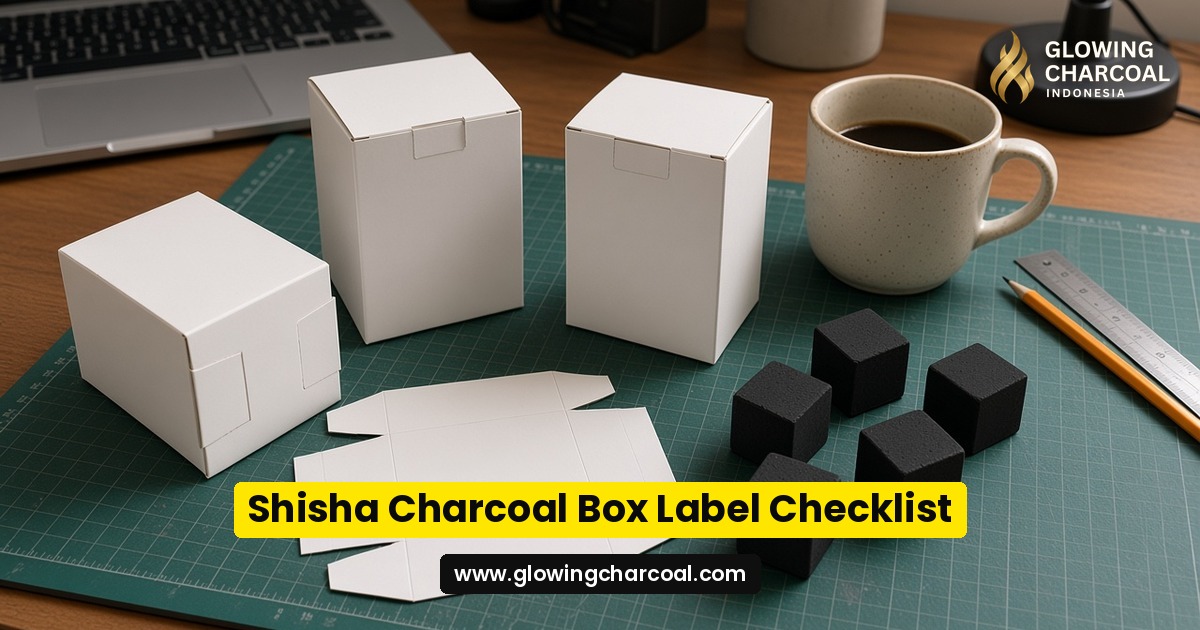
A private-label shisha charcoal box usually carries eight things: your brand, a plain product description, net weight and piece count, “Made in Indonesia”, the brand owner or importer’s name and address, a batch or lot code, short use and safety instructions, and a barcode if you sell in retail. At Glowing Charcoal Indonesia (PT Bara Coco Agronesia), we print your approved artwork on the inner boxes and master cartons, and every export master carton also carries the UN 1361 marking and the Class 4.2 hazard label, because coconut shell charcoal ships as dangerous goods. Your importer confirms the exact wording and languages for each market before anything is printed.
This checklist is for brand owners, distributors launching a house brand and lounge groups that want their own box. It explains what goes on the inner box, what goes on the master carton, which details come from you and which come from the factory, and how to brief us so the first print run is right. It is practical guidance from the factory side, not legal advice.
What Must a Shisha Charcoal Box Say?
Think of the label in two layers. The inner box (for example 1 kg, 500 g or 250 g) is what the lounge or shop customer sees. The master carton (usually 10 kg) is what the shipping line, port, warehouse and customs officer see. Each layer has a different job.
| Label element | Inner box | Master carton | Who provides it |
|---|---|---|---|
| Brand name and logo | Yes | Yes | Brand owner |
| Product description (e.g. “Natural coconut shell charcoal for shisha”) | Yes | Yes | Brand owner, checked by factory |
| Net weight and piece count / cube size | Yes | Yes (plus gross weight) | Factory confirms, brand owner approves |
| Country of origin: “Made in Indonesia” | Yes | Yes | Factory |
| Brand owner / importer name and address | Yes | Usually | Brand owner or importer |
| Batch or lot code | Yes | Yes | Factory (printed or stamped at packing) |
| Use and safety instructions | Yes | Short handling marks | Brand owner, in the market’s language |
| Barcode | If sold in retail | Optional carton code | Brand owner |
| UN 1361 marking and Class 4.2 label | Not usually | Yes, for sea freight | Factory, per dangerous goods rules |
The rest of this guide goes through each layer and the questions buyers ask us most often.
Which Details Go on the Inner Box?
The inner box sells the product and tells the user how to handle it. For a private-label shisha charcoal box we suggest these panels:
- Brand name and logo. This is your artwork. Make sure the name is cleared and protected in your own market before you print thousands of boxes.
- A plain product description. For example “Natural coconut shell charcoal for shisha” or “Coconut shell hookah charcoal”. Our shisha grades are made from 100% coconut shell, so that statement is accurate for them.
- Net weight and piece count. State the net weight (for example 1 kg) and, if you like, the number of cubes and the cube size. Cube count depends on size, so confirm both with us from the approved sample.
- Country of origin. “Made in Indonesia” or “Product of Indonesia”.
- Brand owner or importer details. Company name, postal address and an email or website, as your market requires.
- Batch or lot code. A space where we print or stamp the production code at packing.
- Use and safety instructions. Short, plain steps: light on an electric or gas burner until fully glowing, use with ventilation, keep away from children, store dry. Your importer confirms the exact warning text for your market.
- Barcode. If you sell to shops or online, you supply the barcode number from your own registration; the factory only prints it.
Can we print “100% coconut shell” on the box?
Yes, for our shisha grades, because they are made only from coconut shell. Keep every other claim just as factual. Statements you can back with a document, such as lab results from our Sucofindo Certificate of Analysis, are safer than broad words like “eco-friendly” or “chemical-free” that a market regulator may ask you to prove.
Which language should the inner box use?
Use the language your customers and authorities expect in the market where the box is sold. Brands often print English plus one local language, for example Arabic for Gulf markets or German for Germany. If you sell in several countries, decide the languages before artwork starts, because adding a language after proof approval means a new proof and possibly a new print run.
What Goes on the Master Carton?
The master carton is a shipping unit. It needs clear shipping marks that let the port, warehouse and customs match it to the paperwork:
- Brand name and product description
- Number of inner boxes and net weight per carton (for example 10 x 1 kg = 10 kg net), plus gross weight
- Batch or lot code and, if you want, the production month
- “Made in Indonesia”
- Handling marks such as “keep dry”
- The UN 1361 marking and the Class 4.2 hazard label
Master cartons can be plain brown or printed in full colour. Brown is common for bulk supply, while full colour suits cartons that go straight to a shop floor.
Why does a shisha charcoal carton carry UN 1361 and a Class 4.2 label?
Coconut shell charcoal is shipped as UN 1361 (carbon, animal or vegetable origin), Class 4.2 dangerous goods. Under the dangerous goods packing rules, each package must show the proper shipping name and the UN number preceded by “UN”, and carry the hazard label for its class. The IMDG Code (section 5.2.1) sets the “UN” mark at least 12 mm high, or at least 6 mm on packages of 30 kg net or less, and the UN Model Regulations set the hazard label at a minimum of 100 mm x 100 mm, placed near the shipping name where the package is large enough. Carriers check these marks before loading, so we put them on every export master carton. You can read more in our posts on UN and DG logos on charcoal packaging and what UN 1361 means for coconut charcoal.
Leave space for these marks on your carton design. If the dangerous goods panel is squeezed into a corner or covered by tape, it has to be relabelled before loading, which can delay the container.
Do EU Rules Ask for Extra Details on the Box?
If your boxes are sold to consumers in the European Union, the EU General Product Safety Regulation (Regulation (EU) 2023/988, applicable since 13 December 2024) is the rule most importers check first. Article 9 asks manufacturers to give a type, batch or serial number or another identifier, plus their name, registered trade name or trade mark and a postal and electronic address, on the product or, where that is not possible, on the packaging or an accompanying document. Article 11 asks the EU importer to add its own name and contact address in the same way, without covering the manufacturer’s details, and to make sure instructions and safety information are in a language consumers in that country can easily understand.
For a private-label charcoal box, that usually means a batch code, the brand owner’s contact details and the EU importer’s details on the box, and safety text in the local language. Article 19 adds that online listings must show the manufacturer’s details, product identification and warnings. Your EU importer decides how this applies to your product; we print what they approve.
What Should You Confirm with Your Importer for Other Markets?
Rules differ by country and change over time, so we never guess at another market’s legal text. Before artwork starts, ask your importer or customs broker:
- Which languages must appear on the retail box?
- Must the importer’s name and address be printed, or can a sticker be added after arrival?
- Is any specific warning wording required for charcoal or for shisha accessories?
- Does customs expect “Made in Indonesia” in a particular form or position?
- Do retailers or marketplaces need a barcode on the inner box or on the carton?
- Are any words or claims not allowed on shisha-related packaging in this market?
Send us their answers together with your artwork, and we will check that the dieline has room for everything.
How Does the Batch Code Link to Quality Records?
A batch code is the bridge between a box on a shelf and the production records behind it. If a lounge reports a problem, the code tells us when the charcoal was made and packed. It also helps you show customers that the product matches the lab results you publish. These are the figures behind our Diamond grade:
| Specification | Diamond grade |
|---|---|
| Raw material | 100% coconut shell |
| Ash content | 1.6–2% |
| Moisture | Under 6% |
| Calorific value | About 8,000 kcal/kg |
| Drop test | Minimum 5 drops from 1 meter height |
| Lab report | Sucofindo Certificate of Analysis No. E01021/COBHAT (2 March 2026): total moisture 4.46%, ash 2.00%, volatile matter 9.43%, fixed carbon 84.11% (as received) |
The same Sucofindo certificate can be used for our Diamond and Premium grades. We also hold a Sucofindo Self Heating Test (No. E01003/COBHAT); the charcoal is still classified and shipped as UN 1361 Class 4.2 dangerous goods. If you want to quote lab figures on your box or website, use the exact figures from the certificate and keep the certificate number on file. Our post on shisha charcoal backed by verified laboratory results explains how to read the report.
How Do You Brief the Factory on Box Labels?
A clean brief saves proof rounds. This is the order we recommend:
- Fix the formats. Choose the inner box size (1 kg, 500 g or 250 g), cube size and master carton (usually 10 kg). Each box size has its own dieline.
- Ask us for the dielines. We send the flat layout for each box so the panels, folds and glue flaps are in the right place.
- Collect the market text. Get the importer’s answers on languages, warnings, addresses and barcodes.
- Lay out the mandatory panels first. Put the legal and shipping information in place, then design the brand panels around it.
- Send print-ready artwork. Vector files with fonts outlined, built on our dieline.
- Approve the proof in writing. Check spelling, weights, the origin line, the batch code space and the dangerous goods panel on the master carton.
- Production starts. Lead time is 28–35 days from the deposit and artwork approval, so a late label change moves the loading date.
- Check photos before loading. Ask for photos of packed inner boxes and master cartons, with batch codes visible, before the container is closed.
Our private label shisha charcoal timeline shows how artwork approval fits into the full order, and our OEM coconut charcoal service page explains what we can produce under your brand.
What Are the Most Common Box Label Mistakes?
- Net weight that does not match the packed weight. Confirm cube count and weight from the approved sample before printing.
- No space for the batch code. Leave a clear, unvarnished area where a code can be printed or stamped.
- Missing importer details for the destination market. Ask your importer early, not after the boxes are printed.
- Claims you cannot prove. Stick to facts such as “100% coconut shell” and lab figures you can show.
- A dangerous goods panel that is too small or hidden. Keep the UN 1361 marking and Class 4.2 label clear on the master carton.
- Changing languages after proof approval. This restarts the proof and can delay production.
Shisha Charcoal Box Label Checklist
| Check before you approve the proof | Done? |
|---|---|
| Brand name cleared and protected in your market | ☐ |
| Product description is factual (e.g. natural coconut shell charcoal for shisha) | ☐ |
| Net weight, piece count and cube size match the approved sample | ☐ |
| “Made in Indonesia” on inner box and master carton | ☐ |
| Brand owner and importer name and address as the market requires | ☐ |
| Clear space for the batch or lot code | ☐ |
| Use and safety instructions in the right languages | ☐ |
| Barcode supplied by you, if selling in retail | ☐ |
| UN 1361 marking and Class 4.2 label on the master carton | ☐ |
| Proof approved in writing before production | ☐ |
If you are still choosing a product, our coconut charcoal briquettes for shisha page lists our grades, and our guide on how to test shisha charcoal samples helps you approve the charcoal before you approve the box.
Frequently Asked Questions
What information goes on a shisha charcoal box?
A shisha charcoal box usually shows the brand, a plain product description, net weight and piece count, “Made in Indonesia”, the brand owner or importer’s details, a batch code, use and safety instructions, and a barcode if it is sold in retail.
Does the factory decide the legal text on a private-label box?
No, the brand owner and the importer confirm the legal wording and languages for each market, and Glowing Charcoal Indonesia prints the approved artwork and adds the shipping and dangerous goods marks to the master cartons.
Why do shisha charcoal master cartons show UN 1361?
Shisha charcoal master cartons show UN 1361 and a Class 4.2 hazard label because coconut shell charcoal is shipped as UN 1361 Class 4.2 dangerous goods, and carriers check these marks before loading.
Can a private-label box say “100% coconut shell”?
Yes, a private-label box can say “100% coconut shell” when it contains Glowing Charcoal Indonesia’s shisha grades, which are made only from coconut shell.
How long does production take after the label artwork is approved?
Production at Glowing Charcoal Indonesia takes 28–35 days from the deposit and artwork approval, so any label change after approval can move the loading date.
What is the minimum order for a private-label shisha charcoal box?
The minimum order is 18 tons in a 20ft container with one product type, while a 40ft container can carry two product types at 13 tons each.
Which documents come with a private-label shisha charcoal shipment?
A private-label shipment comes with the usual export documents, the UN 1361 dangerous goods documents and an MSDS, and the goods are declared on the bill of lading as “Coconut shell charcoal briquettes” under HS code 4402.20.10.
Request a Quote or Free Sample
Planning your own shisha charcoal box? Send us your box size, cube size, destination market and a first draft of your artwork or brand guidelines, and we will send the dielines and point out anything missing from the label before you go to proof. We ship FOB Semarang, Jakarta (Tanjung Priok) or Surabaya depending on vessel availability, and we can also handle the shipment until the container reaches your port of discharge. Payment is a 50% deposit with the balance 5 days before container loading by T/T, or an irrevocable L/C at sight.
Samples are free; you only pay the courier cost by bank transfer to our company account. Email info@glowingcharcoal.com or WhatsApp +62 812-8400-6660 to request a quote or a free sample.