
EU-Indonesia CEPA: What It Means for European Shisha Charcoal Buyers
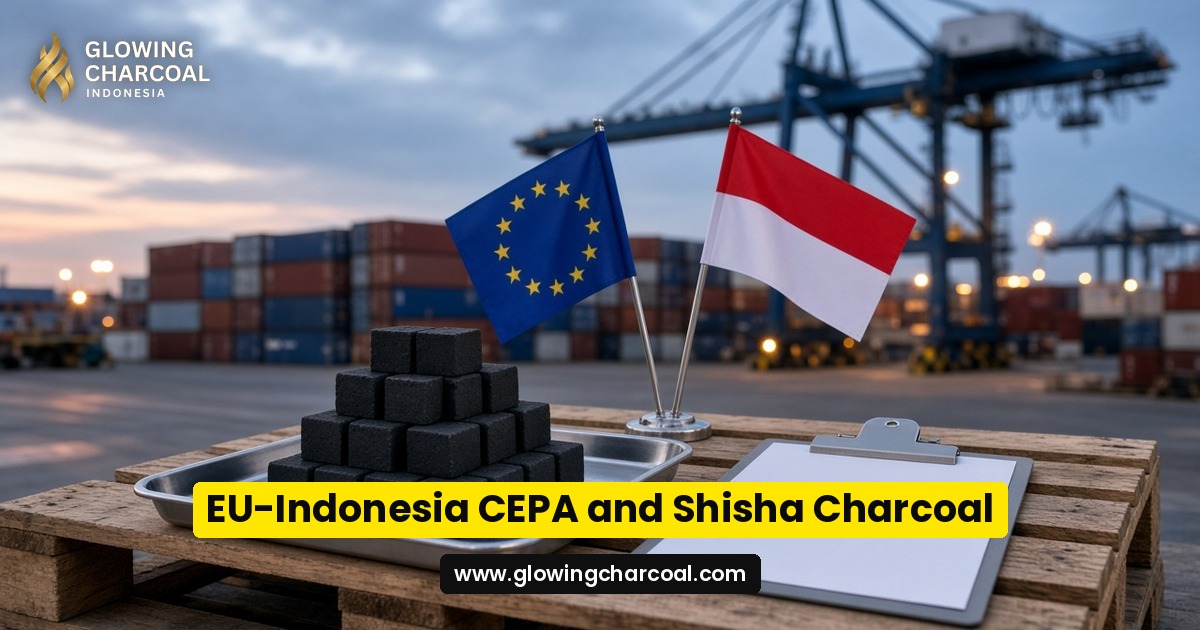
The EU-Indonesia Comprehensive Economic Partnership Agreement (CEPA), signed in Brussels on 21 November 2026, will not lower the import duty on coconut shell shisha charcoal, because the EU already charges 0% on shell charcoal under HS 4402.20. What the agreement does give European shisha brand owners, distributors and lounges is a stable, long-term trade framework with Indonesia, the country many of them already buy their hookah charcoal from, just as Indonesia leaves the EU’s Generalised Scheme of Preferences (GSP) on 1 January 2027. Glowing Charcoal Indonesia (PT Bara Coco Agronesia), a 100% coconut shell charcoal manufacturer in Jepara, Central Java, explains below what changes, what stays the same and what to check before your next container.
The facts in this article were checked against official EU and Indonesian government sources on 25 November 2026. It is general information for charcoal buyers, not legal or customs advice, so always confirm your own position with your customs broker.
What Is the EU-Indonesia CEPA?
The CEPA is a free trade and economic partnership agreement between the European Union and Indonesia. According to the European Commission, negotiations were launched in July 2016 and concluded in September 2025, and the two sides also signed a separate Investment Protection Agreement. Indonesia’s Government Communication Agency (Bakom) reports that the agreement was signed in Brussels on 21 November 2026, after 19 formal negotiating rounds.
The headline numbers from the two governments:
- Tariffs: the European Commission says 98.5% of tariffs will be eliminated. Bakom describes it as around 98% of tariff lines.
- Indonesian exports to the EU: Bakom says 90.4% of Indonesian exports will get immediate access once the deal applies, with tariffs on the remaining 8.37% phased out over 2 to 15 years or managed through tariff-rate quotas.
- Scope: beyond tariffs, the agreement covers customs procedures, services, investment, intellectual property, sustainable development and a protocol on palm oil, according to the Commission.
When Will the CEPA Start to Apply?
Not yet. Signature is a milestone, not the finish line. The agreement still needs the consent of the European Parliament, and Indonesia is carrying out its own internal ratification. Once both sides have completed their procedures, the agreement will be applied provisionally. The European Commission says this is “likely in early 2027”. Bakom reports that the agreement is expected to take effect on 1 January 2027. The Council of the EU said on 18 November 2026 that both sides are committed to bringing the agreements into application as swiftly as possible, in view of Indonesia’s graduation from the GSP on 1 January 2027.
In practice, treat early 2027 as the expected start and watch for the official publication in the EU’s Official Journal before you plan anything around a specific date.
Does the CEPA Cut Import Duty on Coconut Shell Shisha Charcoal?
No, and it is worth being clear about this, because some headlines suggest that every Indonesian product will suddenly become cheaper to import. Coconut shell shisha charcoal is classified under HS heading 4402, wood charcoal “including shell or nut charcoal”, subheading 4402.20 for shell or nut charcoal. Our export documents use the Indonesian code HS 4402.20.10.
When we checked the EU’s TARIC database on 25 November 2026, the third-country (MFN) duty for EU code 4402 20 00 was 0%, applying to imports from every country. The agreement cannot remove a duty that is already zero. A European importer of 100% coconut shell charcoal from Indonesia pays no EU customs duty on it today and is expected to pay none after the CEPA applies. Import VAT and any national taxes are separate from customs duty and are not covered here.
| Topic | Today (November 2026) | Once the CEPA applies (expected early 2027) |
|---|---|---|
| EU customs duty on HS 4402.20 shell charcoal | 0% for all countries (TARIC, checked 25 Nov 2026) | 0%, no change |
| Indonesia’s status under the EU GSP | Beneficiary until 31 December 2026 | Removed from 1 January 2027; the CEPA becomes the preferential framework |
| Dangerous goods shipping | UN 1361, Class 4.2, MSDS provided with the shipment | No change |
| EU and national product rules (labelling, local shisha rules and other requirements) | Apply to the EU importer and seller | Still apply; a trade agreement does not replace them |
So if a supplier tells you the CEPA will make their charcoal duty-free, ask what they mean. For shell charcoal, it already is.
Why Does Indonesia’s Exit from the EU GSP Matter?
The GSP is the EU’s scheme of lower tariffs for developing countries. Under Commission Delegated Regulation (EU) 2025/1951, Indonesia is removed from the list of GSP beneficiaries with effect from 1 January 2027, because the World Bank classified it as an upper-middle-income country for three consecutive years (2023, 2024 and 2025). From that date, Indonesian exports no longer get GSP preferential tariffs.
For many Indonesian products that still carry an EU duty, the CEPA is what fills that gap, which is why both sides want it applied quickly. For shell charcoal, GSP status never changed the duty, because the standard rate is already zero. The real point for charcoal buyers is that Indonesia’s trade relationship with the EU is moving from a one-sided preference scheme, which the EU can review every year, to a negotiated agreement that both sides have signed.
What Actually Changes for European Shisha Brands, Distributors and Lounges?
If the duty stays at zero, why should a hookah charcoal buyer in Germany, the Netherlands, France or anywhere else in the EU care? Because duty is only one part of supply risk. These are the practical benefits:
- A stable, long-term framework. European Commission President Ursula von der Leyen said at the signing that the agreement would give businesses greater predictability, with clear rules and a stable framework for trade and investment in the years ahead (as reported by Bakom). For a brand owner planning a private label range or a distributor signing yearly supply plans, that predictability matters.
- Cooperation on customs. The Commission lists easier and simpler customs procedures among the agreement’s benefits, and the published agreement texts include a protocol on mutual administrative assistance in customs matters. Smoother cooperation between customs authorities helps everyone who ships regularly between the two markets.
- Confidence in Indonesia as a sourcing country. Indonesia is a major source of coconut shell shisha charcoal. A signed agreement with the EU, which already has trade agreements with Singapore and Vietnam in the region according to the Commission, signals that the trade relationship is built to last.
- Other Indonesian products. If you also import other Indonesian goods that carry an EU duty today, check the CEPA tariff schedule for those product lines with your broker. They are the products where the agreement may save money.
What About Rules of Origin and the Statement on Origin?
Under the rules of origin chapter that the European Commission published in 2025 (published for information and subject to legal revision), an importer claims preferential treatment on the basis of a statement on origin made out by the exporter, or, where the importing country allows it, on the importer’s own knowledge that the product originates. The importer is responsible for the correctness of the claim.
For coconut shell charcoal, the standard EU duty is already 0%, so there is normally no duty to save by claiming preference. Ask your customs broker whether a preference claim makes sense for your shipments. What does help in every case is clean paperwork: a clear product description, the correct HS code and documents that show the charcoal is produced in Indonesia. Our guide to the documents required when importing charcoal from Indonesia lists what a typical shipment carries.
What Stays the Same When You Ship Shisha Charcoal to the EU?
The CEPA is a trade agreement. It does not change how charcoal is shipped or the rules your product must meet once it lands:
- Dangerous goods. Our coconut shell charcoal ships as UN 1361, Class 4.2 dangerous goods, with DG marks on the cartons and the MSDS provided with the shipment. Carrier acceptance, DG booking and space are unaffected by the agreement. Read more in understanding UN 1361.
- HS code. Export documents state HS 4402.20.10. Confirm the matching EU import code with your broker.
- Incoterms and ports. We sell FOB Semarang, Jakarta or Surabaya. Freight, insurance and EU-side costs are still arranged by the buyer or forwarder. If you are new to these terms, see FOB, CIF and what they mean for your charcoal import.
- EU and national product rules. Labelling, local rules for shisha venues and any other EU or national requirements that apply to your product are still the responsibility of the EU importer and seller. The CEPA does not replace them, so review them separately with your broker or adviser.
What Does a Reliable Indonesian Supplier Look Like for EU Buyers?
A trade agreement makes the relationship between the two markets more predictable. It does not make every supplier reliable. When you compare Indonesian shisha charcoal factories, look for verifiable specifications, independent test results and clear commercial terms. This is what we offer European buyers:
- Raw material: 100% coconut shell in all three grades, Diamond, Premium and Standard.
- Diamond grade specification: ash 1.6–2%, moisture under 6% and about 8,000 kcal/kg.
- Independent lab results: Sucofindo certificate of analysis No. E01021/COBHAT, as received: moisture 4.46%, ash 2.00%, volatile matter 9.43% and fixed carbon 84.11%.
- Capacity and experience: about 8–10 tons per day, established in 2016, exporting to more than 35 countries.
- Order terms: MOQ 18 tons. A 20ft container carries one product type (up to 18.5 tons); a 40ft can carry two product types at 13 tons each (up to 26 tons). Lead time is 28–35 days.
- Payment: 50% deposit and the balance 5 days before loading, by T/T (preferred) or irrevocable L/C at sight.
- Packing: customisable retail boxes, usually 250 g, 500 g or 1 kg, in 10 kg or 20 kg master cartons, or bulk packing in master cartons, usually 10 kg for safer shipment.
A Short Checklist for EU Buyers Before 2027
- Confirm your import code. Agree the CN code for 100% coconut shell charcoal with your customs broker and make sure it matches the supplier’s documents.
- Check TARIC on the day. Duty rates can change, so check the current rate in TARIC before each shipment rather than relying on an article, including this one.
- Keep your origin paperwork tidy. Keep the commercial invoice, packing list, bill of lading and any origin documents on file for each container.
- Plan for DG shipping. Book with carriers that accept UN 1361 cargo and allow for the 28–35 day production lead time plus transit.
- Review your local rules. Check labelling and any national requirements for each EU country you sell in; the CEPA does not change them.
- Test before you commit. Request free samples and compare them with the certificate of analysis before your first order.
Frequently Asked Questions
When was the EU-Indonesia CEPA signed?
The EU-Indonesia Comprehensive Economic Partnership Agreement was signed in Brussels on 21 November 2026, according to Indonesia’s Government Communication Agency (Bakom), after negotiations that began in July 2016.
When will the EU-Indonesia CEPA come into effect?
The CEPA still needs the European Parliament’s consent and Indonesian ratification; the European Commission expects provisional application likely in early 2027, and Bakom reports an expected start on 1 January 2027.
Does the CEPA remove EU import duty on coconut shell charcoal?
No, because there is no duty to remove: the EU’s standard third-country duty on shell charcoal under HS 4402.20 was already 0% when checked in TARIC on 25 November 2026, so the CEPA does not change the duty on coconut shell shisha charcoal.
What happens to Indonesia’s GSP status in the EU?
Indonesia is removed from the EU’s Generalised Scheme of Preferences from 1 January 2027 under Delegated Regulation (EU) 2025/1951, and the CEPA is intended to replace those preferences with a negotiated, long-term trade framework.
Is coconut shell shisha charcoal still shipped as dangerous goods?
Yes, Glowing Charcoal Indonesia ships coconut shell charcoal as UN 1361, Class 4.2 dangerous goods under HS 4402.20.10, with the MSDS provided with the shipment, and the CEPA does not change these shipping rules.
Which ports do you ship from to Europe?
Glowing Charcoal Indonesia sells FOB Semarang, Jakarta or Surabaya, and the buyer or the buyer’s forwarder arranges ocean freight to the European port of destination.
Are samples free for European buyers?
Yes, Glowing Charcoal Indonesia sends shisha charcoal samples free of charge to buyers in Europe and elsewhere, and the buyer only pays the courier cost by bank transfer to the company account.
Request a Quote or Free Sample
Planning your 2027 shisha charcoal supply for the European market? Tell us your grade, cube size, pack format, expected volume and destination port, and we will prepare a quote and send free samples so you can test the cubes before you order.
Samples are free; you only pay the courier cost by bank transfer to our company account. Email info@glowingcharcoal.com or WhatsApp +62 812-8400-6660 to request a quote or a free sample.