
How to Test Shisha Charcoal Samples Before Your First Order: A Buyer’s Checklist
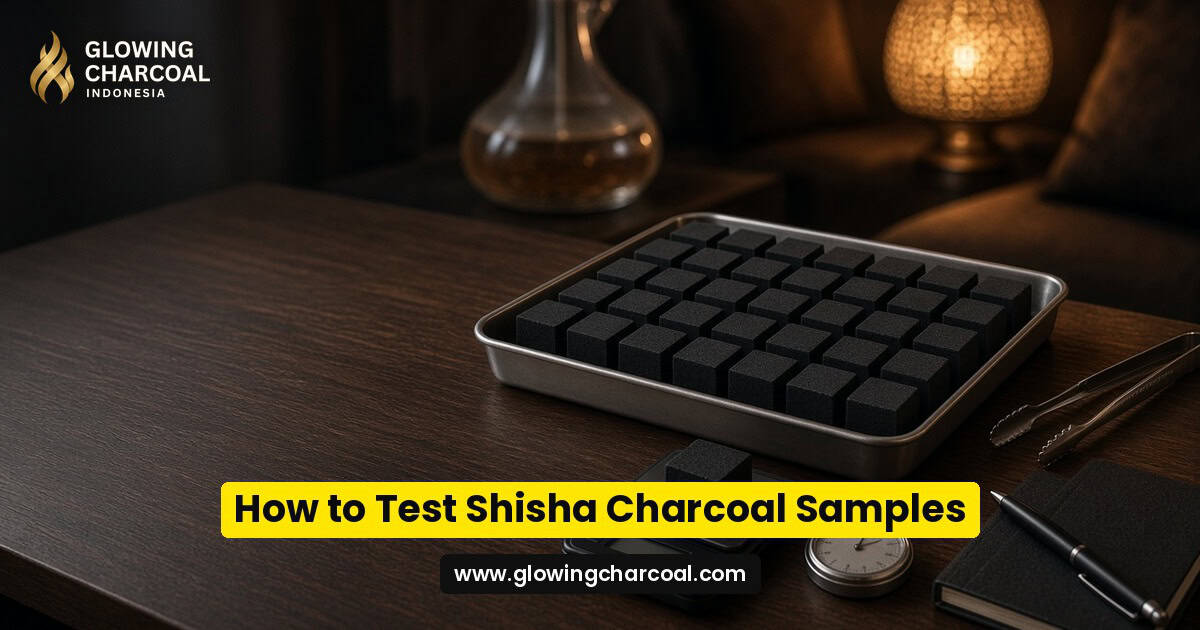
A sample box is the cheapest insurance you will ever buy. Before you commit to a full container, a few hours of careful testing tells you more about a supplier than any catalogue or price list. Yet many lounge owners, distributors and private-label brand owners light two or three cubes, smoke one bowl and decide on a feeling. This guide shows how to test shisha charcoal samples in a simple, repeatable way at your lounge or warehouse, so you can compare suppliers fairly and order with confidence.
You do not need a laboratory. You need a kitchen scale, a timer, your usual burner and bowls, a notebook and the same routine for every sample. The goal is not a perfect scientific result. It is a fair side-by-side comparison under the conditions your customers actually smoke in.
Before You Start: Prepare a Fair Test
The most common mistake is testing samples on different days, on different burners, with different staff. Small changes in airflow, humidity and bowl setup can make a good charcoal look average or an average one look good. Set up your test once and repeat it exactly for every supplier.
What you need
- A digital scale that reads to at least 0.1 g (0.01 g is better for the ash check)
- Your normal burner: electric coil, gas stove or the starter your lounge uses every night
- Two or three of your most common bowl and heat-management setups
- A timer or phone stopwatch, and a phone camera for photos and short videos
- Heat-resistant tray, tongs and a fire-safe container for spent coals
- A simple score sheet (see the table below)
How many cubes to test
Do not judge a supplier on one cube. Take cubes from different boxes or bags in the sample, and test at least five to ten pieces for each check. Label every cube or group with the supplier, grade and size so you never mix them up. Keep the samples sealed until the test, in a dry place, because charcoal can pick up moisture from humid air.
Step 1: Look and Touch Before You Light
Open the box and spread a handful of cubes on a white sheet of paper. Good coconut shell charcoal looks uniformly deep black, with clean, sharp edges and a smooth, dense surface. Check for:
- Size consistency: measure a few cubes with a ruler or caliper. Pieces in one box should be the same size and shape, because your staff and customers expect each bowl to behave the same way.
- Weight consistency: weigh ten cubes one by one. Large differences in weight usually mean uneven pressing or density.
- Cracks, chips and dust: a little dust after a long courier journey is normal; many broken pieces and loose powder are not.
- Smell: unlit charcoal should smell neutral. A chemical, sour or smoky smell is a warning sign.
- Black marks: rub a cube on the paper. Every charcoal leaves some mark, but compare how much each sample leaves, since this affects how clean your staff’s hands and trays stay.
For more on visual warning signs, see our guide on how to spot fake or low-quality coconut charcoal briquettes.
Step 2: The Drop Test
Your charcoal will travel thousands of kilometres by truck and ship, then be handled again in your warehouse and lounge. Hardness matters. Drop several cubes, one at a time, from about one metre onto a hard floor. Record how many stay whole, how many chip at the corners and how many break into pieces. Use the same height and the same floor for every supplier. A dense, well-pressed cube should survive with little more than slight edge wear.
Step 3: Ignition Test
Place the same number of cubes from each sample on your usual burner at the same setting. Start the timer and note when each cube is fully glowing across all its faces, not just at one corner. Write down:
- How long it takes until the whole surface is evenly lit
- Whether the cube sparks, pops or cracks during heating
- Any smoke or odour while lighting
- Whether the cube still holds its shape when you pick it up with tongs
Cubes that crack or split on the burner are a real problem in a busy lounge. We explain why in why premium hookah charcoal should not break during ignition.
Step 4: Session and Burn Time Test
This is the test that matters most to your customers. Prepare identical bowls with the same tobacco, the same packing and the same number of cubes. Smoke each one the way your lounge normally serves it, ideally with the same staff member managing the heat.
- Heat-up time: how many minutes until the bowl gives good, steady clouds
- Usable heat: how long the cubes keep the bowl smoking well before they need replacing
- Heat stability: does the heat stay even, or does it spike and burn the tobacco?
- Taste: any harsh, burnt or chemical taste that is not from the tobacco
For a fuller picture, also burn a few cubes on a wire grid in still air and note how long they glow. A grid test is easy to repeat and compare, but remember that a bowl with airflow burns differently, so use both results together.
Step 5: Ash Check
When the cubes are fully spent and cold, look at what is left. Clean-burning coconut shell charcoal leaves a small amount of light, fine ash that falls away easily. Heavy, dark, crusty or fused ash, or ash that clings to the cube and blocks heat, suggests a lower-quality raw material, too much binder or poor carbonisation. Our article on the impact of ash colour on hookah charcoal quality explains what different ash colours can mean.
You can also make a rough ash estimate. Weigh a cube before lighting, let it burn out completely on a clean heat-resistant dish, let it cool, then weigh the ash. Ash weight divided by the starting weight, times 100, gives an approximate ash percentage. Home results are only indicative, because some ash is always lost, but they are useful for comparing samples side by side.
Score Sheet: Compare Samples Side by Side
Use a simple sheet like the one below for every supplier and grade. Score each line from 1 (poor) to 5 (excellent) and add notes and photos.
| Check | What to record | Score 1–5 |
|---|---|---|
| Appearance | Uniform black colour, sharp edges, size and weight consistency | |
| Drop test | Whole / chipped / broken out of the cubes dropped | |
| Ignition | Minutes to full glow; sparks, cracks, smell | |
| Session | Heat-up time, usable heat, stability, taste | |
| Ash | Amount, colour, how easily it falls away; rough ash % | |
| Packaging | Condition on arrival, sealing, protection of cubes |
Compare Your Results with the Lab Report
A practical test tells you how the charcoal performs in your lounge. A laboratory report tells you what it is made of. You need both. Ask every supplier for a recent Certificate of Analysis from an independent laboratory and check that it covers moisture, ash, volatile matter and fixed carbon, and states whether results are "as received" or on a dry basis. Then ask yourself whether your sample behaved the way the numbers suggest. Low ash on paper should mean little ash in your bowl; low moisture should mean clean, even ignition.
Our own shisha charcoal is made from 100% coconut shell, typically sourced from Sumatra or Sulawesi. Our Diamond grade has ash of 1.6–2%, moisture under 6% and a calorific value of about 8,000 kcal/kg, and our quality is tested by Sucofindo, an independent Indonesian inspection company. You can read more in premium shisha charcoal backed by verified laboratory results.
From a Good Sample to a Consistent Container
A great sample only matters if the container matches it. Once you choose a supplier, keep a few cubes of the approved sample as your reference, and ask that production follows the same grade, size and packaging. Agree the details in writing: shape and size, grade, inner box and master carton, and container plan. For your first order, you can also arrange a third-party pre-shipment inspection by a company such as SGS, Sucofindo or Carsurin, at the buyer’s cost, to check the goods against the approved sample before loading.
When you plan the order, remember the practical terms. Our MOQ is 18 tons per 20ft container, and a 20ft container carries one product type only. If you want two types, a 40ft container can carry 2 types at 13 tons each. Lead time is 28–35 days from deposit, and we ship FOB Semarang (Jakarta or Surabaya are possible depending on vessels). Payment is a 50% deposit with the balance 5 days before container loading by T/T, or an irrevocable L/C at sight.
Frequently Asked Questions
How many cubes should I test from each sample?
Test at least five to ten cubes for each check, taken from different boxes or bags. One cube can be lucky or unlucky; a group shows you how consistent the charcoal really is.
Can I measure ash content without a laboratory?
You can make a rough estimate by weighing a cube before burning and weighing the ash afterwards. It is useful for comparing samples, but only a laboratory test gives a reliable ash figure, so check it against the supplier’s Certificate of Analysis.
Why does the same charcoal perform differently in different lounges?
Airflow, bowl type, heat-management setup, tobacco, humidity and how staff light the coals all change the result. That is why you should always test samples under your own normal conditions and with the same setup for every supplier.
Should I test samples in winter or humid weather?
Yes, ideally in the conditions your customers will use the charcoal. Keep samples sealed until testing, because charcoal left open in humid air can absorb moisture and light more slowly.
Are your samples free?
Yes. Our samples are free; you only pay the courier cost, by bank transfer to our company account. We do not accept PayPal. Please send your full delivery address and phone number so we can arrange the courier.
What happens after I approve the sample?
We confirm grade, size, packaging and container plan, then send a quotation. Production starts after the 50% deposit, and lead time is 28–35 days from deposit.
Request a Quote or Free Sample
The best way to judge our charcoal is to test it yourself, in your own bowls, next to what you use today. Tell us your preferred grade, cube size, pack format and destination, and we will send a free sample and a quotation for your first container.
Email info@glowingcharcoal.com or WhatsApp +62 812-8400-6660.