
Why Global Fuel Prices Are Rising — And How We're Making Sure It Doesn't Affect Your Charcoal Order
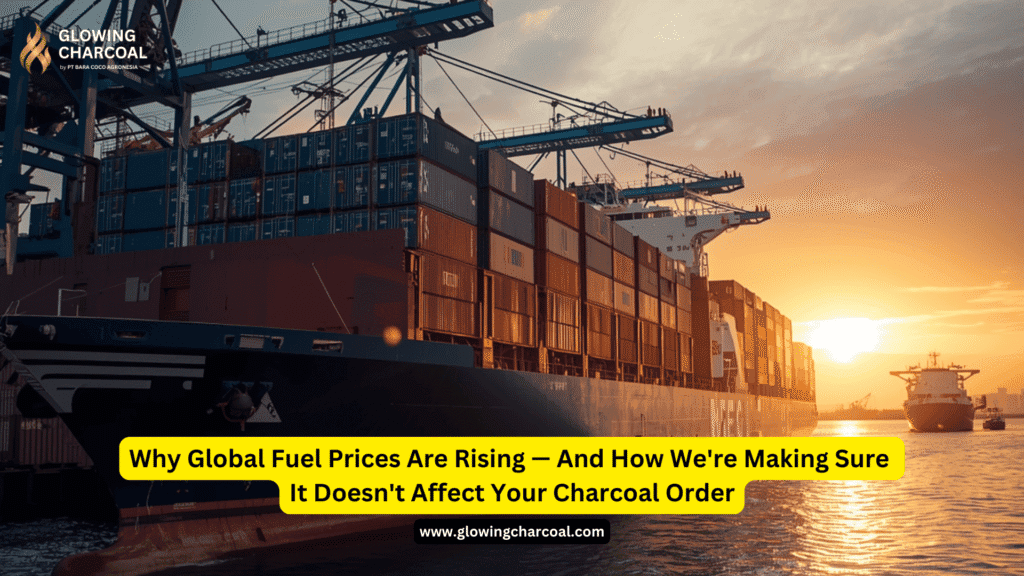
You’ve probably seen the headlines. The Strait of Hormuz — the narrow waterway through which roughly 20% of the world’s seaborne oil and gas passes — has been effectively closed since late February 2026 following the US-Israel military operation against Iran. Tanker traffic has dropped to near zero. Hundreds of ships are sitting idle outside the strait. And fuel prices around the world have surged as a result.
It’s a situation that’s rippling through almost every industry on the planet. And as a coconut charcoal manufacturer that exports worldwide, we want to be completely transparent with you about how it’s affecting us — and what we’re doing to protect your business from the impact.
What the Hormuz Closure Actually Means for Production Costs
When fuel prices rise, it’s not just transportation that gets more expensive. The entire manufacturing supply chain feels it.
For us, one of the most direct impacts has been on packaging materials. Plastic wrapping, stretch film, and the cardboard boxes we use to ship our briquettes all have one thing in common — their production is heavily dependent on petrochemicals and fuel. When oil prices surge toward and beyond $100 per barrel, as analysts at the Dallas Fed have projected for Q2 2026, the cost of these materials rises with it.
That means the box your charcoal arrives in costs more to make. The plastic inner wrap costs more. Even the energy costs involved in running our production facility have crept upward as fuel and electricity prices respond to the global squeeze.
We won’t sugarcoat it — our production costs have gone up. That’s the honest reality of operating during one of the most significant global energy disruptions in decades.
Why We’re Absorbing the Increase — Not Passing It On
Here’s what we want you to know: we have made a deliberate decision not to pass these additional costs on to our wholesale clients.
We know that many of you are navigating your own cost pressures right now. Your shisha lounge clients are dealing with rising operating costs. Your distribution network is under pressure. The last thing you need is your charcoal supplier adding to that burden.
So instead of adjusting our prices upward, we’ve been working hard internally to absorb what we can. That means tightening our own operations, finding efficiencies in how we source and process packaging materials, and accepting that our margins take the hit — not yours.
We see this as an investment in the long-term relationships we’ve built with our wholesale partners. If we raise prices every time global events put pressure on costs, we’re not really a reliable partner — we’re just another supplier passing problems downstream.
What We Can’t Fully Control — And What We’re Doing About It
We want to be honest about the limits of what any manufacturer can absorb over an extended period. If the Strait of Hormuz remains closed for many months — a scenario that US intelligence assessments have described as plausible — the cumulative pressure on packaging and fuel-linked costs will eventually reach a point where adjustments may become unavoidable for the industry as a whole.
What we can promise is this: we will always communicate with you early and clearly. If anything changes in our pricing, you will hear from us directly — with an explanation, reasonable notice, and a conversation about how to make it work for your business. No surprises. No sudden invoice changes.
In the meantime, our production schedule, quality standards, and lead times remain unchanged at 25–30 days. The Hormuz crisis has not disrupted our raw coconut shell supply, which is sourced domestically here in Indonesia. Our core product — the briquette itself — remains consistent and unaffected.
Why Coconut Charcoal From Indonesia Is More Resilient Right Now
There’s an important reason why Glowing Charcoal Indonesia is better positioned than many other charcoal suppliers to weather this crisis.
Our raw material — coconut shell — is 100% locally sourced in Indonesia. We are not dependent on Middle Eastern energy for our primary input. While fuel-linked costs affect our packaging and logistics, we are not exposed to the crude oil supply chain disruption the way that producers in oil-dependent regions are.
This is one of the structural advantages of coconut charcoal from Indonesia that doesn’t always get talked about. When global energy markets are in turmoil, our supply of raw material stays stable.
A Message to Our Wholesale Partners
We know this is an uncertain time for a lot of businesses. The geopolitical situation is changing almost daily, and no one can say with certainty when the Strait of Hormuz will fully reopen or how long elevated fuel prices will persist.
What we can offer you is stability, transparency, and a genuine commitment to protecting your business from the ripple effects of a crisis that neither of us created.
Your orders will be fulfilled on time. Your briquettes will arrive at the same quality they always have. And our prices will stay where they are for as long as we can possibly hold them.
That’s our commitment to you — not because we have to, but because that’s how we believe business should work.
If you have any questions about how the current global situation may affect your upcoming orders, please don’t hesitate to reach out. We’re here, we’re transparent, and we’re in this together.
Glowing Charcoal Indonesia is a leading producer and exporter of premium coconut shell charcoal briquettes for the shisha industry. We offer worldwide wholesale supply and OEM private label services.