Understanding UN 1361: What It Means for Coconut Charcoal Factory
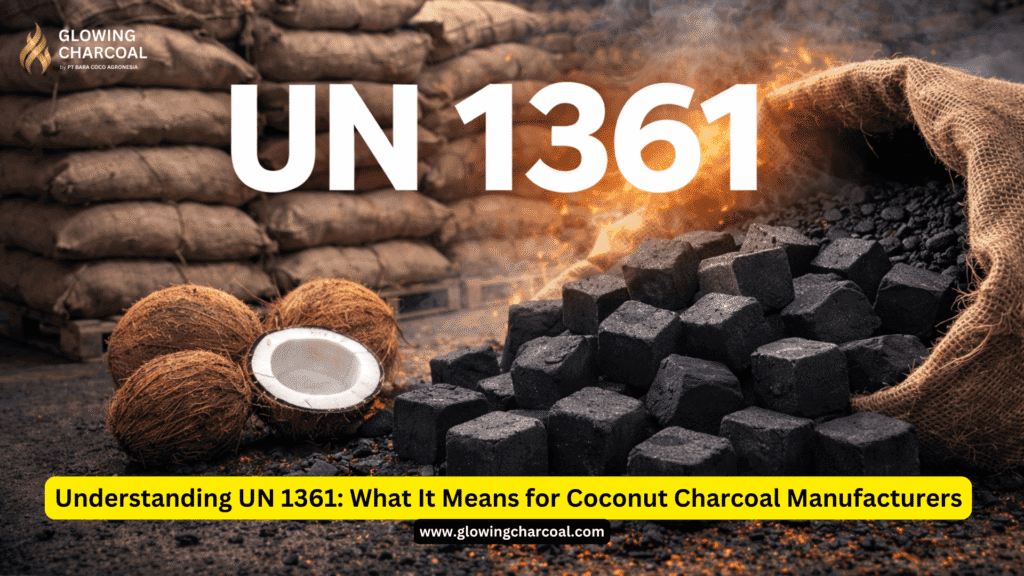
When exporting coconut charcoal briquettes, buyers, shipping lines, and authorities often ask a crucial question: “Is your product UN 1361?” This term frequently appears in export documents, MSDS files, and shipping instructions, yet it is often misunderstood.
In this article, we explain what UN 1361 really means, clarify the common confusion around “certification,” and explain how Glowing Charcoal Indonesia manages UN 1361 compliance to ensure smooth, safe, and reliable global deliveries.
What Is UN 1361?
UN 1361 is a United Nations dangerous goods identification number used in international transportation.
UN Number: 1361
Proper Shipping Name: Carbon, animal or vegetable origin
Hazard Class: 4.2 – Substances liable to spontaneous combustion
This classification commonly applies to coconut charcoal, wood charcoal, and bamboo charcoal, including briquettes used for shisha (hookah) and barbecue (BBQ).
UN 1361 does not describe product quality. Instead, it identifies a potential transport risk related to spontaneous heating if the charcoal is not properly processed or packed.
Why Coconut Charcoal Falls Under UN 1361
Charcoal is produced through a carbonization process that removes volatile components. However, if the charcoal is:
Not fully carbonized
Packed while still warm
Exposed to excess moisture
Poorly ventilated during transport
It may self-heat internally and, in rare cases, ignite.
Because of this potential risk, international transport regulations classify charcoal as Class 4.2, even though properly manufactured coconut charcoal is generally stable and safe for shipping.
Is UN 1361 a Certification? – Clarification from Glowing Charcoal Indonesia
No. UN 1361 is not a certification.
This is one of the most common misunderstandings in the charcoal export industry.
The United Nations does not issue a UN 1361 certificate
UN 1361 is a regulatory classification, not an approval or quality mark
There is no single official document called a “UN 1361 certificate”
When buyers ask for “UN 1361 certification,” they are usually referring to supporting compliance documents, not an actual certificate.
Documents Commonly Associated with UN 1361
To demonstrate compliance when exporting coconut charcoal, factories typically provide the following documents:
1. Material Safety Data Sheet (SDS / MSDS)
An SDS clearly states:
Product name (coconut charcoal briquettes)
UN Number: UN 1361
Hazard Class: 4.2
Handling, storage, and transport guidance
This document is essential for shipping lines and importers.
2. Non-Self-Heating or Proper Carbonization Statement
This is a factory-issued declaration confirming that:
The charcoal is fully carbonized
The product has been properly cooled before packing
Normal transport conditions do not pose a self-heating risk
Many shipping lines rely on this statement.
3. IMDG Code Compliance (Sea Freight)
For ocean transport, charcoal must comply with the IMDG Code. Depending on the shipping line and destination, this may involve:
Dangerous goods declaration, or
Shipment under specific exemptions if allowed
4. Optional Third-Party Test Reports
Some buyers request independent verification from laboratories such as SGS, Intertek, or Bureau Veritas. These reports may include:
Self-heating test (UN N.4)
Moisture content analysis
Fixed carbon and ash content
These tests are not mandatory in all cases, but they add credibility.
Can Coconut Charcoal Be Shipped as Non-DG?
In practice, many shipments of coconut charcoal briquettes are transported without incident. However, classification depends on:
Manufacturing consistency
Moisture control
Packing method
Shipping line policies
Some shipping lines accept coconut charcoal as non-dangerous cargo if supporting documents prove stability. Others like MSC, CMA, and MAERSK Line strictly require declaration under UN 1361, Class 4.2.
Professional manufacturers prepare documentation for both scenarios to avoid delays.
Why Proper UN 1361 Handling Matters
Incorrect or unclear UN 1361 declarations can lead to:
Cargo delays at port
Rejection by shipping lines
Additional inspection costs
Loss of buyer trust
Clear documentation protects both exporter and importer, ensuring smooth customs clearance and safe transport.
How Glowing Charcoal Indonesia Manages UN 1361 Compliance
At Glowing Charcoal Indonesia, UN 1361 compliance is an integral part of our production and export system. We:
Apply controlled and consistent carbonization processes
Ensure complete cooling before packing
Maintain strict moisture control standards
Prepare UN 1361–compliant MSDS documentation
Issue clear non-self-heating and transport safety declarations (SHT Certificate)
Align all export shipments with IMDG Code guidelines
These internal controls allow us to export confidently to international markets without unnecessary delays.
UN 1361 Compliance at Glowing Charcoal Indonesia
At Glowing Charcoal Indonesia, UN 1361 is not treated as a formality—it is a standard we actively comply with across our production and export operations.
Our coconut charcoal briquettes are manufactured under controlled conditions to ensure stability during transport. With proper documentation, IMDG-aligned handling, and experienced export management, our factory is fully compliant with UN 1361 requirements.
We are ready to deliver worldwide without hesitation, supplying shisha and BBQ coconut charcoal to buyers across Europe, the Middle East, Asia, and other global markets.
By choosing Glowing Charcoal Indonesia, you partner with a manufacturer that understands international regulations, respects shipping safety standards, and delivers consistent quality—wherever your market is.